Reading the Lag Signals That Reveal a Construction Workflow Worth Auditing First
Stalled approvals and shifting critical paths show where to audit first.
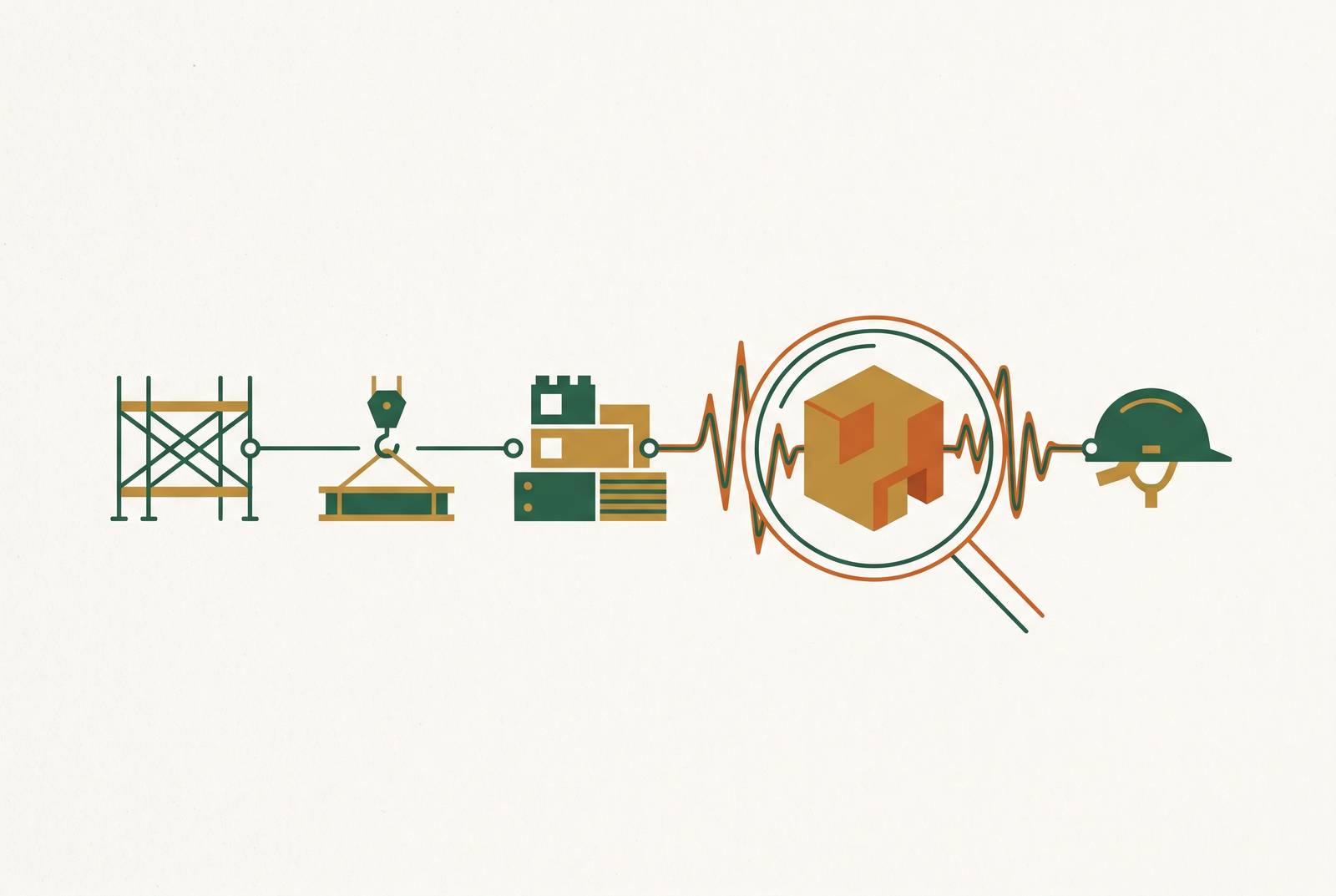
Before deploying AI in construction and logistics operations, a process audit should identify where work repeatedly stalls, changes route, or depends on manual follow-up. In construction, unstable critical paths, fragmented approvals, procurement gaps, and aging RFI or change order clusters identify the workflow worth auditing first. These signals turn an audit into a precise intervention, with the process rebuilt before a tool is chosen.
Why missed finish dates are the wrong signal to follow in a construction workflow
Waiting for a missed finish date to call a workflow broken is intuitive. It is also too late for diagnosis. By then, the reported variance is the consequence of decisions, routing failures, and handoffs that have already shaped the work. The date shows that the plan and execution have diverged, but it does not identify where that divergence began.
Construction lacks alignment between what its declared plans say and what workflows do. A schedule can retain its promised finish while its baseline logic no longer reflects trade sequencing, its approval rules leave decisions unresolved, or its handoffs rely on informal intervention. Those weaknesses are readable before a deadline passes because they appear in how work moves.
Schedule variance still belongs in leadership reporting. The distinction is between tracking performance and diagnosing its causes. Even when variance is the only metric leadership follows, it remains a lagging indicator of upstream churn. If finish dates reveal the result, which earlier patterns reveal the broken process?
What churn in the critical path actually looks like before it shows up as delay
A critical path that changes repeatedly from week to week is one such pattern. Critical activities appear in one report and disappear from the next, while other activities take their place as the work supposedly governing completion. The finish date may not yet have moved. Nevertheless, the changing sequence indicates gaps in agreement on the logic controlling the project, enforcement of that logic, or its connection to how work flows on site.
An auditor can compare weekly schedule reports and track which activities cycle on and off the path before a delay claim. Repeated turnover points to a coordination model that cannot hold its own sequence. Trade sequencing is already unstable even if the headline schedule continues to show an achievable completion date.
A finish-date variance directs attention to lost time, while critical-path churn directs attention to the relationships governing the work. The audit checks whether the stated dependencies match the sequence teams follow. Where those dependencies keep changing, the audit can take a closer look at the scheduling process or how it connects to field coordination.
How fragmented handoff points generate the approval delays that most teams mistake for people problems
Approval churn exposes a related failure in decision flow. When an item bounces between engineering, procurement, and contractors before anyone records a formal decision, the delay can look as though one person is slow to decide. The routing pattern tells a different story. One team may define the workflow, another own the system, and a third manage compliance, leaving the handoff dependent on manual follow-up and tribal knowledge.
California Landscaping Commercial Company illustrates that fragmentation in practice. The company used HubSpot for sales, Excel schedules on internal servers, and separate software for estimating and financials, with project managers and superintendents bridging the gaps manually. The gaps were part of daily work. Project information existed across the business, but moving it between functions depended on people connecting systems that did not provide a coherent operating view.
The same structural weakness can affect submittals, RFIs, purchase approvals, invoice exceptions, contract reviews, inspection signoffs, and handover documentation. These processes cross systems and teams, so a digital form alone cannot fill in missing prerequisites or settle conflicts over approval authority. Process mining can reconstruct actual approval paths from system event logs, exposing rework loops, unauthorized routing variations, and recurring exceptions. That evidence distinguishes a stalled approver from a defective route.
A sound approval architecture defines the business event that triggers routing and the evidence required before it begins. It also defines who can approve by value, risk, discipline, or project phase. Exceptions need a clear route of their own. Service levels and escalation rules then establish when reminders fire and unresolved items move up, rather than leaving each delay to personal intervention.
Why procurement is now the hidden critical path that most workflow audits miss
In electrical infrastructure programs, procurement may set the sequence that determines when work finishes, ahead of the construction activities shown in the P6 schedule. Long-lead commitments can shape what happens on site before the construction sequence takes control. The traditional EPC order has been inverted. Owners are committing large sums of money, including equipment deposits, before they have permits or have fully defined the scope.
That inversion creates a gap between scheduled delivery and the decisions required to support it. A schedule can show material arriving on time while buyout remains pending. The date exists, but the commitment does not. Comparing delivery assumptions with purchase orders, deposit dates, and lead-time commitments reveals whether the schedule rests on procurement activity that has actually occurred.
Cost reporting can conceal another part of that gap. Job-site supervisors make purchases in real time, while leadership may not see the charges until month-end. Teams can then start change order negotiations without knowing what has already been spent. The procurement workflow is then disconnected not only from the schedule but also from the financial information used to govern project decisions.
An audit that looks only at schedule documents cannot check those dependencies. Procurement records belong inside its scope because they show whether planned delivery is supported by actual commitments. For logistics operations considering AI, the applicable audit question is similarly concrete.
Energization readiness as the lag zone that a schedule milestone hides
Energization carries the procurement problem into whether the site is ready to operate. A single downstream milestone can conceal network studies, approvals, connection equipment procurement, reinforcement works, outages, interface agreements, and commissioning. Those activities may be outside the main EPC schedule and still determine the commercial operation date. The milestone is visible, but its governing process is not.
Equipment may be set and cable pulls complete while grounding remains incomplete, terminations are untested, and grid approvals are months away. Physical progress does not resolve those dependencies. A schedule showing energization as weeks away can therefore conflict with unresolved utility queues, protection relay approvals, and connection agreements.
The early signal is the absence of tracked prerequisites. Before commissioning, a schedule that leaves out grid interface activities, utility coordination, or protection scheme testing shows only part of the route to energization. Even a Gantt that looks healthy can have that gap. The workflow is incomplete as a control mechanism if the dependencies governing readiness are absent from it.
Late discovery then changes the character of the problem. Teams compress installation or commissioning to recover earlier delay, transferring schedule pressure into quality, rework, and operational readiness risk. The audit target is consequently not the milestone date itself. It is the process connecting equipment availability, field completion, utility decisions, and commissioning readiness before that date can credibly be achieved.
How RFI cycle times and change order backlogs reveal the process worth auditing first
The practical triage step is to read these signals together, using RFI cycle times and change order backlogs to locate their concentration. These records collect the consequences of coordination failures, fragmented approvals, and procurement gaps. Distribution is more useful than volume alone. A cluster tied to one discipline, subcontractor, project phase, procurement category, or approval domain identifies a more precise audit target than a project-wide total.
RFI response times expose the gap between declared digitization and actual coordination. The average RFI takes 9.7 days to receive a response, but an average alone cannot show which handoff is failing. Long cycles show that work still depends on manual follow-up, people watching inboxes, and tribal knowledge. Their concentration reveals where that dependence is most acute, without treating the people asking questions as the source of the problem.
Change order aging adds a commercial dimension. A large, aging backlog indicates that scope decisions are accumulating outside a governed decision flow, often in email threads and conversations. When those changes cluster around a procurement category or approval domain, they point to the process node the audit should examine. The individual change is evidence.
RFI concentration, repeated approval loops, and unresolved purchasing commitments can point toward the same handoff from different directions. Where they converge, an audit has a specific process to investigate. The objective is not to track every available metric, but to find the recurring stall that explains the most painful accumulation of work.
What should a construction company audit before implementing AI automation tools?
Once the signals identify a process, the audit examines how it actually runs. The team doing the work begins with a step-by-step demonstration, including where it hurts. Documentation describes intent. Comparing the demonstration with the declared workflow exposes the gap that redesign must address before any system or tool is considered.
The examination begins with where project information enters the company and where it becomes stranded. It establishes which system serves as the actual source of truth for project status and whether teams rely on the same one. Schedule ownership must also be explicit. Where schedules are updated, who owns them, and whether that ownership is enforced all help explain why declared dependencies may fail to govern field work.
The audit examines when field decisions reach accounting and when a budget overrun first becomes visible. It also identifies who can change critical workflow structures and whether those permissions are governed or ad hoc. These questions connect the operating process to the reporting and control mechanisms that depend on it.
The output is an operational blueprint. It shows where work breaks down across systems, teams, and handoffs, then separates problems in how the process is built from quick wins. In the landscaping case, the audit made visible a process that leadership could not see in real time. That visibility gives “fix the process, then apply the technology” a concrete meaning, because the redesign addresses demonstrated gaps rather than assumptions about what a new tool might improve.
Why automating before auditing makes the churn faster, not slower
Automation is not a substitute for that blueprint. A digital form can move an approval task without resolving missing prerequisites, duplicate reviews, conflicting authority rules, or poor exception handling. An AI agent placed inside the same structure inherits those unresolved decisions. Faster execution can then make the churn harder to interpret because the workflow produces outputs more quickly from a sequence that remains structurally wrong.
Fragmentation persists when tooling is layered onto an operating model in which process ownership, system ownership, and compliance remain misaligned. The distinction is between automating a task and engineering the end-to-end decision flow. Only the latter establishes how an item becomes ready, who may decide, and what happens when the normal route cannot proceed.
The practical intervention starts with the most painful specific process identified by the signals. That process is audited as it runs today, then rebuilt around explicit prerequisites, authority, handoffs, and exception paths. Tool selection follows those decisions. Automation or AI agents can then operate inside the rebuilt workflow, with a defined role in moving work forward instead of serving as a reporting layer over unresolved process gaps.