What P6 Schedules Actually Capture vs. Field Reality
Procurement gaps, merge-point bias, and stale updates break plans.
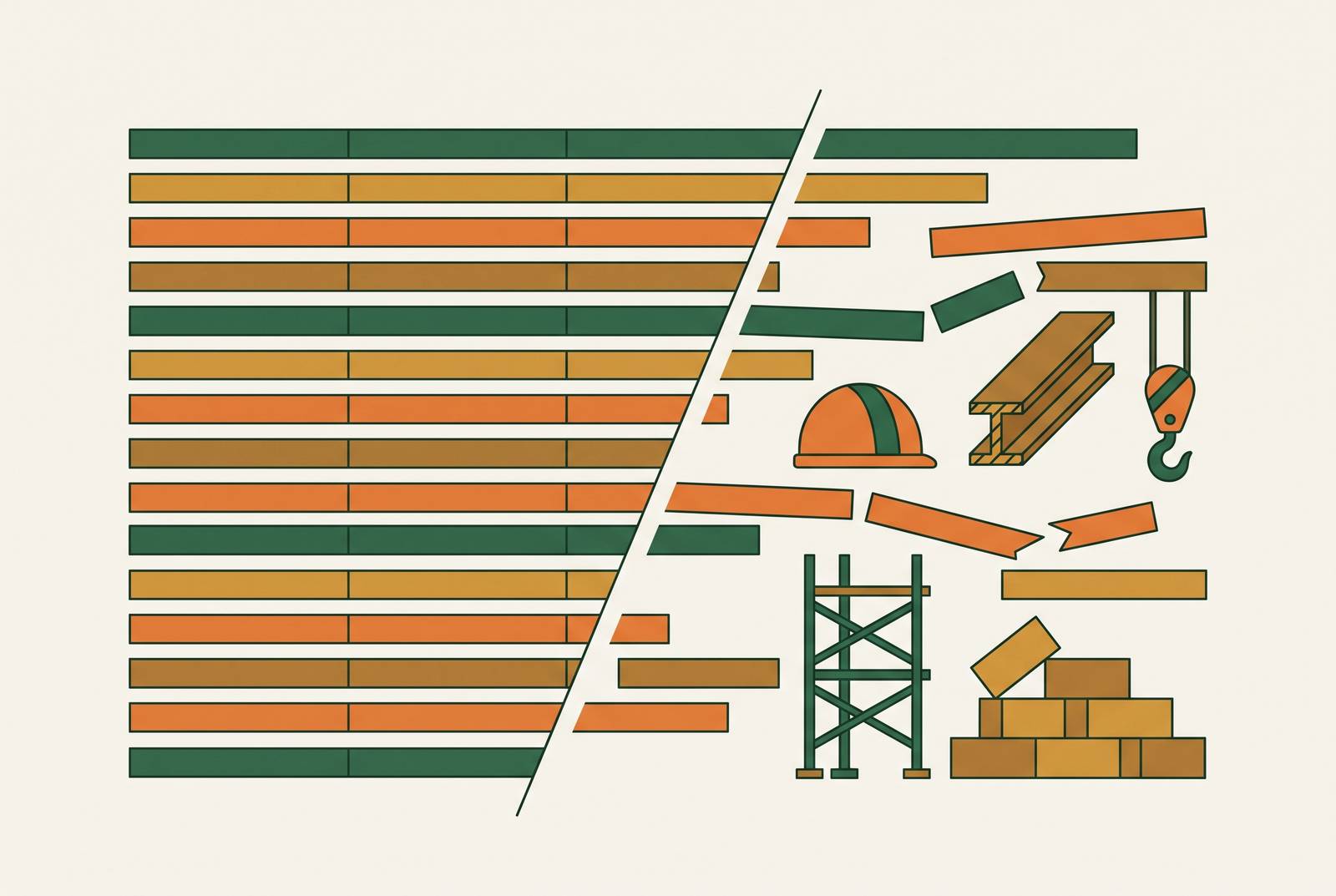
P6 schedules model intent: the sequence work should follow, the float each path carries, the critical route through a program. The risks that actually derail projects live in data P6 never touches. Procurement lead times, crew coordination gaps, merge point congestion, and commissioning readiness determine whether work happens as planned, and none of them appear in the logic.
What P6 is built to do and where its design boundaries fall
P6's core competency is formal planning at scale. The tool handles complex sequencing, float analysis, work breakdown structure development, resource loading, and critical-path modeling across programs containing hundreds of interdependent activities. Its workflow follows a well-established sequence: scope definition, WBS setup, logic-linked activities, resource assignment, constraint management, and critical-path review. This is why P6 remains the default wherever contracts demand formal CPM scheduling on highways, bridges, water treatment plants, and other public infrastructure. The tool is genuinely good at what it was designed to do, and the design intent is unambiguous.
That design intent is worth stating plainly because it explains everything that follows. P6 is built for planners, not crews. Its native output is a schedule document, not a coordination system. Linarc's 2025 analysis notes that most contractors using P6 export static PDFs or Excel snapshots to communicate timelines, and field teams rarely access the live schedule. Any adjustment requires a round trip through the scheduler, an architecture that reflects the tool's fundamental purpose rather than a configuration oversight. P6 models a plan and submits it for review. It does not operate as a living system that field conditions continuously update.
Beneath that architecture sits a modeling choice with consequences that compound silently. P6 is deterministic: one duration per task, typically close to the most likely value. The problem is that task durations are right-skewed. There are many more ways for work to run long than to finish early, so the baseline carries a systematic optimism bias before any field disruption occurs. When firms like Terminal Use begin a process rebuild in construction, the first step is always that audit: seeing precisely where the formal schedule breaks contact with how work actually flows.
How the one-duration-per-task assumption compounds across a network
The deterministic model understates project duration because of two compounding effects that CPM logic ignores: merge-point bias and correlated task uncertainty. Neither is a data-quality problem. Both are mathematical properties of deterministic scheduling applied to branching networks, and they operate even when every individual duration estimate is reasonable.
Merge-point bias follows from how parallel paths converge. Wherever multiple predecessors feed a single node, the merge point must wait for the latest incoming path. Deterministic dates pick the most-likely duration for each predecessor and add them, but the merge point actually finishes when the slowest predecessor finishes, not the average one. Consider two parallel paths feeding a commissioning milestone, each with a most-likely completion in week thirty. The CPM date says week thirty. Reality says the milestone waits for whichever path slips, and with two independent paths there is meaningful probability that at least one runs long. The more parallel paths converge at a single node, the larger the gap between the CPM date and what the network will deliver.
Correlation compounds the effect. Weather, crew productivity, and design maturity drive many tasks simultaneously. A schedule risk analysis that treats task durations as independent will look reassuringly precise while understating the true range. When a crew is slower than planned on one activity, it is often slower on adjacent activities too, and the CPM model has no mechanism to carry that signal forward. The practical consequence is that the baseline end date carries optimism baked in at the model level, before any execution risk materializes. Rebuilding the workflow means confronting that compounded assumption head-on: identifying which processes, merge points, critical-path tasks, commissioning gates, create the most dangerous gap between plan and field reality, and redesigning those first.
Where the schedule loses contact with reality during execution
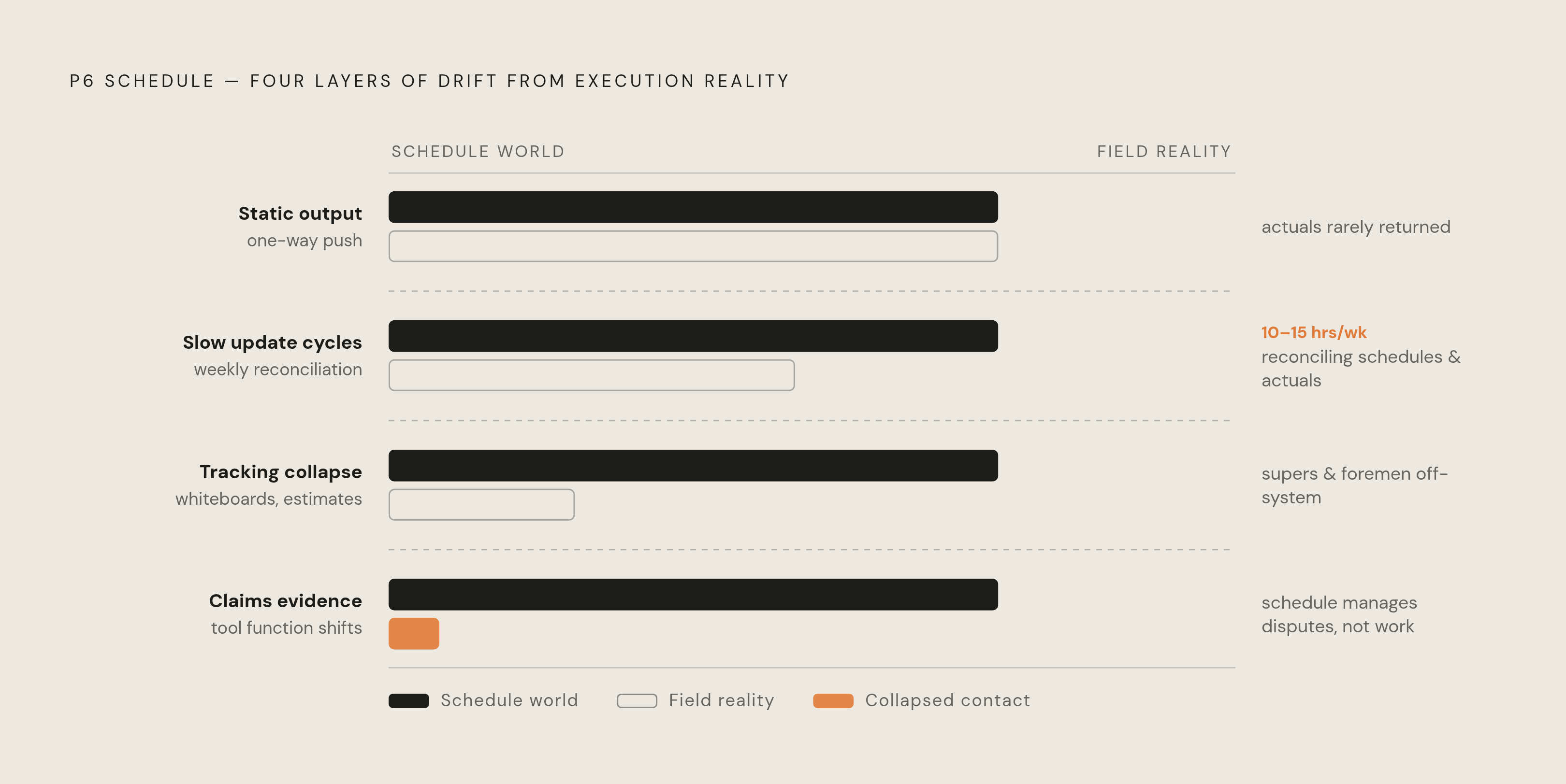
Once a P6 schedule moves into execution, the combination of static output, slow update cycles, and tracking discipline collapse turns it into a ceremonial document. It remains present and reviewed, but it no longer influences outcomes. The information architecture works one way: planners push updates out, field teams rarely push actuals back in. Linarc's analysis describes teams spending ten to fifteen hours per week reconciling schedules, documents, and actuals, time consumed by the gap rather than by managing the project. Superintendents work from whiteboards and texts. Foremen estimate durations. Project managers approve change orders against outdated progress assumptions.
Update latency hides variance until it is too large to absorb quietly. BidSync AI's 2026 analysis frames this as an architecture failure rather than a discipline failure: when updating the master schedule requires exporting files, waiting on a specialist, and waiting for redistribution, updates stop happening. At that point the schedule's primary function shifts from management tool to claims evidence.
The procurement data P6 never sees and why it drives more delays than logic errors do
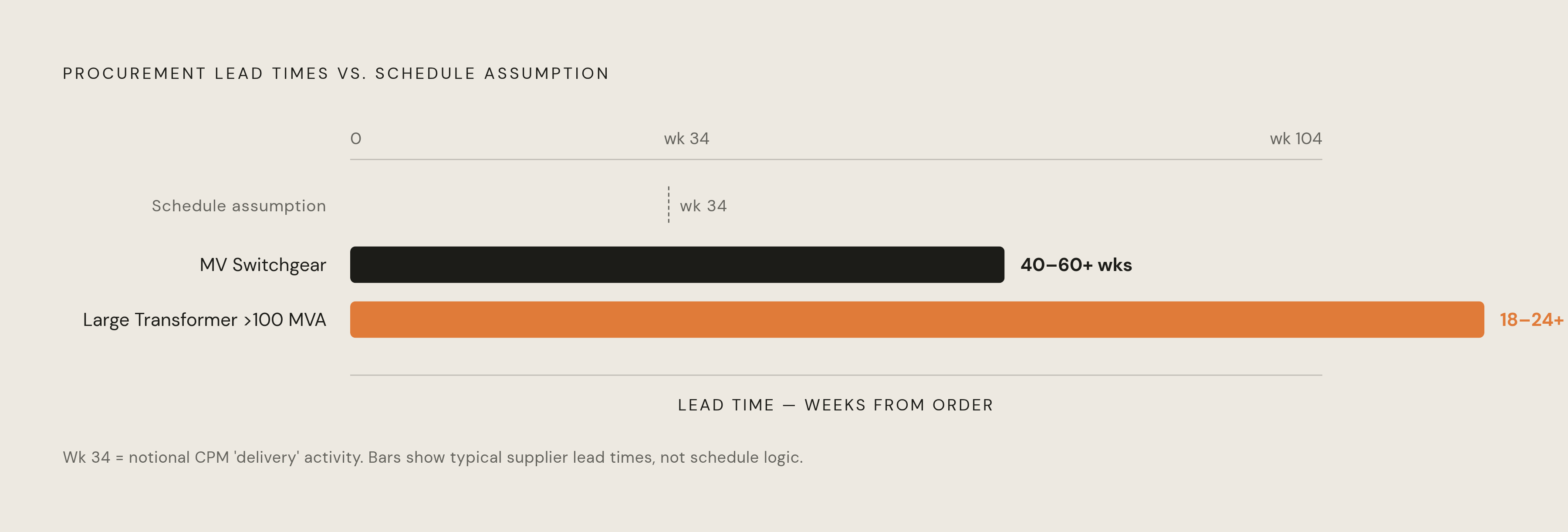
A CPM schedule can identify a contractor, a procurement date, and a construction window without establishing whether the equipment needed for the work will actually arrive on time. On capital-intensive projects, that gap between schedule logic and supply-chain reality is where the most expensive delays originate. The mechanisms are concrete and measurable, and they sit entirely outside the schedule model.
Long-lead equipment runs on timelines that CPM logic does not model as constraints. iRecruit's procurement analysis documents medium-voltage switchgear at forty to sixty or more weeks and large power transformers above 100 MVA at eighteen to twenty-four months or more in the U.S. market. Brennan Church of Hut 8 states the operational consequence directly: "A shell can be completed and mechanically roughed in, but if the gear isn't onsite, you're not energizing." A schedule activity called "switchgear delivery" with a planned duration and a finish-to-start link to installation captures a hope, not a supply-chain commitment.
Even when material data exists, it is not influencing real construction decisions in real time. Utilities and contractors build field plans on assumed readiness, not verified availability. The schedule says the gear arrives in week thirty-four, but no one has confirmed the manufacturer's current lead time against that date. Crews cannot be assumed into existence the way schedule logic assumes materials, and a schedule may sequence work correctly while remaining entirely silent on whether the crews required to execute that sequence will be available at the planned time.
Why commissioning and energization expose the full cost of treating the schedule as a proxy for readiness
Commissioning has historically been modeled as a fixed, predictable phase near the end of a construction schedule. That assumption is breaking down as the pool of qualified specialists is drawn from by an expanding capital investment pipeline, and the CPM schedule has no mechanism to model that resource constraint. Physical completion and energization are not the same milestone, and the gap between them is not captured in most schedules.
Environment and Energy Leader's commissioning coverage describes the final utility-side energization step as a bottleneck that planning approval and construction completion do not resolve on their own. Even after a transformer physically arrives on site, it must be tested and certified before energization, and that testing step has its own separate queue of qualified electrical and protection testing specialists. The CPM schedule models commissioning as an internal activity. The actual constraint is external, shared, and invisible to the schedule logic.
The nuclear construction pattern makes the systemic nature explicit. MATRIX's June 2026 guidance describes what it calls the "execution gap" in nuclear construction: the persistent disconnect between how projects are planned and how they unfold in the field, identified as an industry-wide systemic pattern across the nuclear industry. MATRIX's proposed corrective, embedding field-experienced professionals directly into client and vendor teams, is itself evidence that the schedule alone cannot carry coordination at the commissioning stage. When a finished building cannot be energized, the schedule was never tracking the real constraint.
What schedulers who manage outcomes do differently from schedulers who manage plans
The distinction between managing a plan and managing an outcome is not a question of which scheduling tool is in use. It is a question of what data disciplines surround the schedule and how quickly field variance reaches the people who can act on it. The practices that close the gap are operational, not technological.
Short-interval planning is the bridge between the CPM baseline and field execution. Lookahead schedules, typically covering three to six weeks, force conversations between trades about constraints: drawings released, materials on site, access granted. BidSync AI's 2026 field comparison describes the Last Planner System pull-planning tradition as the discipline behind short-interval lookahead scheduling that forces conversations between trades and makes work executable. The weakness of pull planning without live data is equally clear: boards need a facilitator and current information, and without a connection back to the master schedule, the lookahead becomes its own island.
Live field data flowing upward into the schedule changes what is visible and when. When daily reports, time cards, and quantity installs flow upward automatically, a two-day drift surfaces on Wednesday rather than at month-end, while recovery is still a staffing call rather than a resequencing crisis. Procurement syncing to execution means long-lead orders are placed against realistic need dates instead of schedule optimism. Operations leaders who manage outcomes treat commissioning as a resource-constrained activity rather than a fixed endpoint. They identify the commissioning specialist queue as a procurement problem to be tracked in parallel with construction, not a phase to be scheduled after mechanical completion. The same logic applies to utility coordination: energization readiness requires a confirmed external queue position, not a finish milestone in the CPM.
How AI-first process redesign changes what the scheduling workflow can do
The case for AI-first redesign in construction scheduling is not that AI speeds up existing workflows. Procore stores RFIs, Autodesk tracks submittals, Oracle logs the schedule, but none of them chase the architect for a response or catch a missing attachment before routing. The result is structural: construction professionals spend a substantial share of working hours searching for project information, resolving conflicts, and managing rework, time that is structural to the workflow rather than a personal productivity problem.
Foundry's October 2026 analysis distinguishes between bolting AI onto legacy workflows to speed up reports and using AI's capacity for faster learning, adaptive decisions, and precise coordination to completely redesign workflows. The former produces faster reconciliation. The latter eliminates the need for it. In agentic configurations, the system senses disruptions earlier, acts faster, and learns continuously, transforming the plan-execute-feedback loop into a continuous intelligent system rather than a monthly reporting cycle.
Terminal Use approaches the scheduling-adjacent operations workflow by rebuilding the process rather than layering a reporting tool onto P6. The firm first has the client show how a process runs today and where it hurts, then conducts a process audit, and works together with the client to decide what to rebuild first. In construction, logistics, and manufacturing, that approach redesigns the specific, painful handoff processes, procurement tracking, commissioning coordination, field data collection, with AI agents at the center rather than bolted on as a downstream layer. The promise of a live first process within weeks rather than quarters reflects a position that long timelines signal the wrong approach: automating a broken coordination workflow makes it worse faster, so the starting point is always process redesign, not tool deployment. Terminal Use's team brings direct experience rebuilding operations for major engineering, procurement, and construction firms, as well as companies that run operations at national scale such as medical billing, which grounds the approach in field-verified failure modes rather than theoretical frameworks.
Other tools address parts of the gap without redesigning the underlying process. Opteam provides reporting and dashboard tooling that converts P6 schedule data into client-ready outputs, reducing the time planners spend producing status reports. It serves teams whose bottleneck is reporting rather than field coordination.
The organizational readiness condition that determines whether any of this works
The scheduling gap between CPM intent and field reality cannot be closed by purchasing better tools if the underlying data flows, coordination rhythms, and process ownership remain unchanged. Supply Chain Management Review's 2026 analysis notes that AI-first operations in supply chain and manufacturing require clean data, standardized processes, and disciplined governance to scale, and the same conditions apply to construction scheduling workflows. In 2026, the primary constraint for many organizations is organizational readiness: the ability to share data responsibly, collaborate across silos, and build the operating rhythms that sustain change.
The strongest objection deserves a direct answer. The problem arises when organizations treat the CPM schedule as both contractual record and live coordination system. It was designed for the former, and using it as the latter is what creates the execution gap.
The starting point is always a specific, painful process, not a platform strategy. For most construction and infrastructure operations leaders, that painful process is a specific handoff. The gap lives in the coordination and data disciplines around it, and closing that gap starts with an honest audit of where the process actually breaks, not with a software decision.