Process Audit Methodology for Operations Leaders
How to find where real work diverges from the documented process.
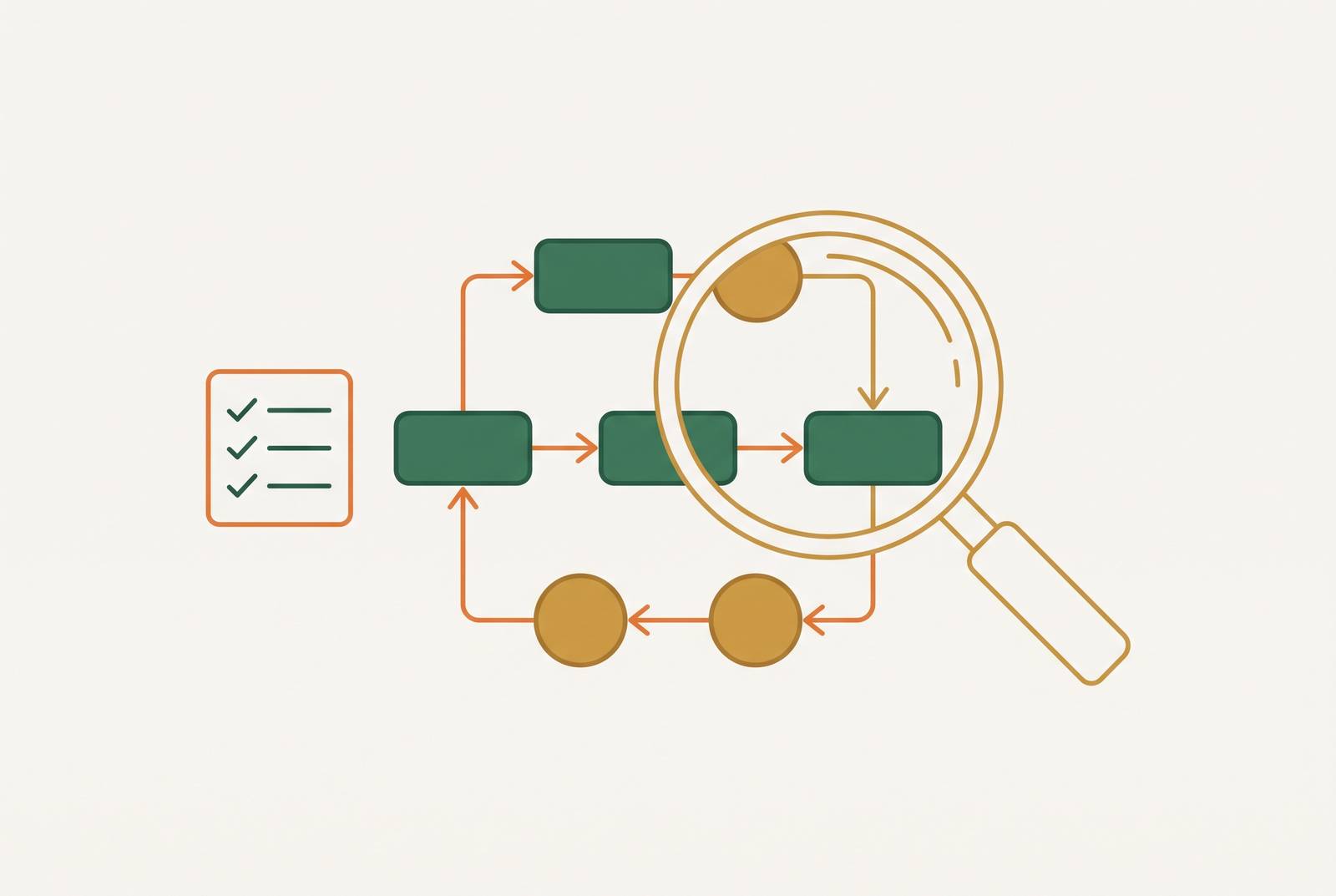
A status report can read green even as the crew is improvising a workaround nobody wrote down, because the step that was supposed to happen never had the inputs it needed. That gap between the report and the floor is the default condition of any operation that has been running for more than a few months, and it is the reason process audits so often surface a process nobody remembers approving.
Work changes faster than the documents meant to describe it. New constraints appear, informal fixes get adopted because they work well enough, and escalation paths form around whoever happens to answer the phone, and none of this ever makes it back into the SOP. Documentation freezes a moment; the floor keeps moving. Left alone, that divergence compounds, and organizations that build improvement programs or AI deployments on top of the documented version end up automating the wrong process, which makes the resulting failures faster to trigger and far harder to walk back.
What a process audit is trying to find
A process audit does not exist to confirm that a workflow diagram matches a laminated binder somewhere in a site trailer. Its job is to find where work slows down, stalls, gets rerouted around a bottleneck, or quietly generates rework that never appears on a dashboard.
That means starting from evidence rather than assumption. An audit built around the org chart or the SOP is working backward from an answer someone already believes; an audit built around cycle time data and exception logs is working forward from what the operation is actually doing. The second approach costs more time up front and returns something the first one cannot: a factual account of where the process breaks, rather than a confirmation of where it was designed to work.
Starting with direct observation, not interviews or documents
Rigor starts with watching the work run before asking anyone to explain it, because explanation reflects what people believe should be happening, not necessarily what is. When a superintendent describes how a change order moves through approval, the answer usually describes the intended path. Standing at the point where the paperwork actually changes hands reveals a different picture.
Direct observation catches the sequence of steps as they actually occur, including the informal ones that never made it into any procedure document. It also catches something interviews structurally cannot: the informal steps a team has performed so often that no one on the crew still registers them as deviations. C|On a procurement handoff for a mid-size commercial project, that might mean watching a purchasing coordinator call a supplier directly to confirm a delivery window rather than trusting the promised-date field in the system, because the field has been wrong often enough that nobody checks it anymore. A layered audit approach, running checks at multiple levels of the same process, gives leaders more than one view of the same work and shows if the documented standard actually holds up once real conditions get applied to it.
Following an artifact end to end matters more than following a person. Tracking the purchase order, the permit, or the shipment as it physically or digitally moves from one party to the next makes the handoffs where things go quiet obvious fairly quickly. Queue time, the interval where the artifact is simply waiting on someone's desk or in someone's inbox, tends to account for a disproportionate share of total cycle time and almost never appears in any status report.
How to read the signals that documented processes can't show
Observation generates raw material. Reading it well means treating each pattern as a specific diagnostic signal rather than an anecdote to mention in a debrief.
Cycle time stretch is the first signal worth learning to spot. When a step runs materially longer than its declared standard, the cause is almost always one of three things: someone is waiting on a decision, someone is compensating for information that should have arrived already, or someone is redoing work that was done incorrectly upstream. Mapping where the stretch occurs reveals the upstream cause producing it, because teams tend to describe the symptom they feel rather than that cause.
Exception frequency tells a second story. A single exception is just noise. A cluster of exceptions on the same step or the same handoff means the process cannot handle the actual range of inputs arriving at that point, and in construction procurement, recurring exceptions tied to vendor delivery commitments or material spec changes are among the most common precursors to downstream schedule variance.
Manual overrides and shadow tools form a third signal class. Every spreadsheet a team maintains alongside the official system is a record of a gap the system does not close. An auditor should ask what that spreadsheet does that the system doesn't, and the answer usually points to a missing data field, a missing workflow step, or a missing decision owner.
Ownership gaps round out the picture. RACI charts assign roles to tasks on paper, but observation reveals if the responsible role is actually reachable at the moment a handoff needs it and if anyone is watching the transition happen. Governance breaks down when nobody owns the threshold for escalating a problem and when status reporting is built to avoid friction rather than surface it, and field observation is positioned to catch those gaps before a missed deadline forces them into view.
The questions to ask once observation is complete
Observation maps what is happening. Structured questions establish why, and who actually has the standing to change it.
The sequencing matters here: ask about the work itself before asking about the systems supporting it, and ask about the systems before asking about the organization around them. At the work level, the sharpest questions sound almost mundane: what does this step need that the previous step doesn't reliably hand off? What would have to be true for this handoff to move faster? What happens the moment the input shows up incomplete? At the system level, the questions shift toward friction: where does the system force a step the work itself doesn't require? Where is a person manually translating between systems that were never built to talk to each other? What critical information exists only in somebody's head or a buried email thread?
Organizational questions cut the deepest, and the governance question is usually the sharpest. Plenty of organizations have steering committees, RACI documents, and status templates in place, and critical decisions still drift anyway, because leaders are never actually forced to choose between competing trade-offs and reporting is built to smooth over friction rather than expose it. Ask directly: when did this process last force a senior decision, and what happened when it did? A process that never escalates is either running cleanly or concealing how badly it isn't.
When an interviewee's account of the process contradicts what was actually observed, treat the contradiction itself as a finding. It usually means the team has lost visibility into its own work. The better follow-up is walking through the observed sequence together and asking where their expectation and the reality split apart; that conversation tends to surface the workaround's actual origin story, which is often more useful than the workaround itself.
How to sequence the investigation across a complex operation
Every department in a complex operation has problems worth auditing, so sequencing by pain and dependency works better than sequencing by org chart or process map. Auditing everything at once produces a survey. Auditing the right thing first produces leverage.
The process should sit on the critical path, where a failure delays or degrades everything downstream of it. It should already be generating visible signals: SLA breaches, exceptions leadership has quietly accepted as routine, or rework everyone acknowledges but nobody has fixed. And it needs to be small enough to be observed completely in a reasonable time window, but large enough that fixing it produces measurable impact, which is close to what McKinsey describes in the AEC context as a domain: end-to-end and independently redesignable.
Before committing to that starting point, trace one full cycle of the most painful process backward and mark every upstream input it depends on. The dependency chain, not the org chart, tells the auditor where the failure actually originates. In construction, that trace usually runs through procurement and material delivery before it ever touches the schedule itself, since delays and variance in scheduling often trace back to how supplier commitments were tracked well upstream. In logistics and supply chain operations, the trace tends to end at a data handoff, such as a carrier update that lands too late to act on or a customs clearance that stays invisible until it becomes a crisis; that gap pushed Altana to acquire Cervo AI in pursuit of an end-to-end agentic AI platform for customs brokerage.
Auditors and the leaders sponsoring them both gravitate toward the processes that are easiest to audit: well-documented, cooperative teams, available data, easy conversations. Those are rarely where the real exposure sits. Deferred fixes, repeat exceptions, and workarounds treated as temporary all look individually reasonable in isolation. The audit's actual value comes from stacking them together and reading the pattern as a system rather than as a series of unrelated incidents.
How date pressure affects process visibility
Deadline pressure is the single most reliable way an audit gets cut short before it finds anything real, because pressure makes a workaround look like a solution and compression look like efficiency instead of risk.
Once a delivery date gets locked in before the discovery work is actually finished, the organization inherits a false sense of certainty about its own readiness. From that point forward, testing compresses, risk management turns performative, and hidden rework multiplies beneath a schedule that still looks fine on paper. Teams under that kind of pressure tend to describe the process they intend to run rather than the one currently running, because intention is what's easiest to talk about when the deadline is close. Exception handling speeds up too: workarounds that would normally form a recurring pattern over weeks instead get absorbed as one-off responses to urgency, and their structural cause disappears from view.
Auditing through that pressure requires a few deliberate adjustments. Trust the log over the narrative, since the gap between what people say and what the cycle time data, exception records, and override histories actually show widens the most exactly when the deadline is closest. Ask directly about exceptions: walk through the last three times this step didn't go as planned. Under pressure, those three examples will be recent, and they'll describe the process as it currently runs rather than the version leadership hopes is running. Track what's being deferred, too: compressed timelines push remediation into "later," and workarounds that were flagged as temporary quietly become permanent, so the audit should keep an explicit inventory of what got deferred and when.
Construction offers a clean parallel in commissioning. On projects tied to digital infrastructure builds, energization readiness has become a hard dependency that date pressure routinely papers over, since delivery and profitability increasingly hinge on power energization schedules that don't bend for anyone's deadline. Commissioning readiness reviews run under schedule pressure consistently underreport their own dependency gaps, mostly because teams conflate a task being planned with a task actually being on track. Planned and on track are not the same claim, and treating them as interchangeable lets a schedule slip without anyone noticing until it's already late.
What the audit produces: a map of where the process can be rebuilt, not just improved
A completed audit hands leadership something more specific than a list of inefficiencies. It hands them a map of where the gap between documented process and actual behavior is narrow enough to close with a fix, and where that gap has grown wide enough that the underlying process needs to be rebuilt before anyone automates or scales it.
That distinction carries real weight for any AI deployment or improvement initiative under consideration. A process with occasional cycle time stretch and a handful of ownership gaps can absorb targeted correction: clarify the RACI, add the missing data field, close the loop on the handoff that keeps stalling. A process riddled with clustered exceptions, shadow spreadsheets standing in for missing system capability, and governance that never forces a real decision is not a tuning problem. Automating that version locks in its failure modes and makes them run faster, exactly the outcome that observation-first auditing exists to prevent. The map the audit produces tells leadership which processes are worth improving and which ones need to be taken apart and rebuilt from the evidence up, before any technology gets layered on top of them. Terminal Use, an AI-first operations firm that deploys live AI agents to run department workflows end to end for construction, logistics, manufacturing, and retail companies, begins every engagement with exactly this kind of audit before rebuilding anything.