Why Automating Broken Workflows Accelerates Failure
Automation executes flawed processes at scale, so fix them first.
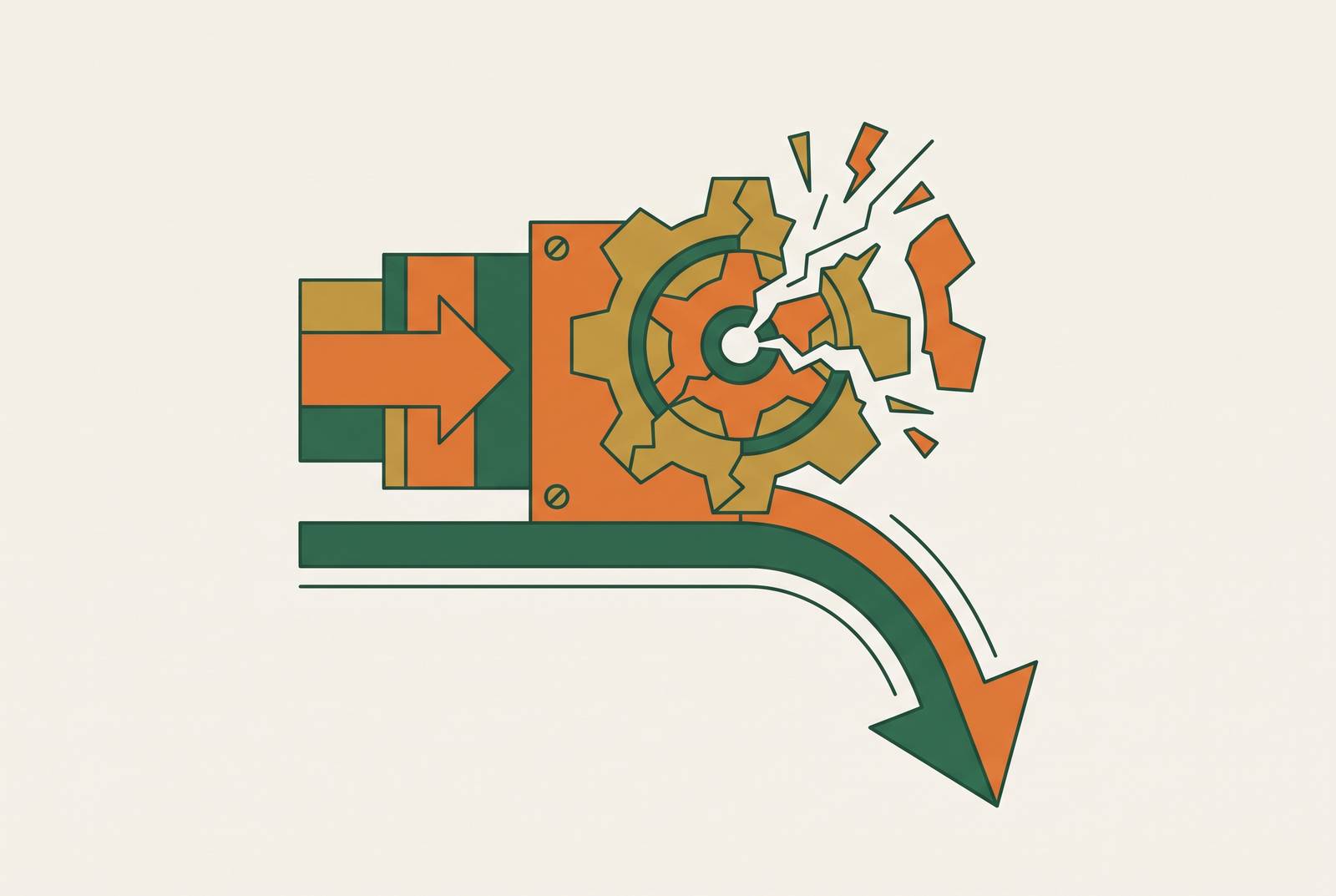
Enterprise AI spending is accelerating while the operational returns on that spending are not. Companies are not failing to invest; they are failing to convert investment into results, and the reason is that most of them are automating individual tasks instead of redesigning the workflows that actually generate business value.
Harvard Business Review's analysis by Shunko and Netessine lays out the disconnect in stark terms. Corporations expect to roughly double their AI spending this year as a share of revenue, yet only a small minority of CEOs report both revenue gains and cost savings from that spending, and most organizations report no enterprise-wide EBIT impact at all. That is a strange result for a technology that has been marketed, funded, and staffed as a transformation engine. Budgets keep climbing. Pilots keep multiplying. The scoreboard at the level that matters, enterprise profit, stays roughly where it started.
The easy conclusion is that the technology is overhyped and underdelivering. That reading misses what is actually happening on the ground: organizations are deploying AI into processes that were never structurally capable of producing the outcome they are asking AI to produce. The model is not the constraint. The workflow underneath it is.
Abandonment figures back this up. Automation project abandonment rates jumped sharply within a single year, and most AI initiatives in flight are projected to be abandoned through 2026 because their outputs can't be trusted. The initiatives are not being scrapped because the underlying technology failed to perform a task. They are being scrapped because what the technology was fed, a process full of undocumented judgment calls, inconsistent handoffs, and informal workarounds, was already broken before automation touched it. The investment curve and the returns curve have diverged, and a process problem wearing a technology costume produced the gap between them. It is a process problem wearing a technology costume.
Automation enforces a broken process instead of correcting it
Automation does not audit the process it inherits. It executes that process, faithfully and repeatedly, at a speed and scale no human team could match. When the process is structurally sound, that consistency is an asset. When the process is not, automation becomes a mechanism for producing flawed outcomes rapidly and at volume, rather than correcting them.
CX Today's analysis describes the mechanism without ambiguity: AI takes the decision logic already embedded in a workflow, the rules, the priorities, the ad hoc handling of edge cases, and repeats that logic faster, wider, and with far more consistency than any human team ever could. Under stable conditions, that consistency compounds value. Under unstable conditions, it multiplies liability rather than accelerating performance.
The structural reason this happens is specific. Before automation, people quietly absorb the exceptions a process was never designed to handle. A phone number goes missing, and someone notices and calls to get it. Someone catches the misrouted order before it ships. Someone remembers that a particular client always needs a manual override on invoicing. None of that improvisation appears in a process map, and none of it survives automation. NHIMG's July 2026 analysis names the effect directly: automation removes the human safety net that had been masking weak process design, so incomplete inputs, inconsistent approvals, and fragmented ownership stop being manageable delays and start arriving as hard failures.
AI Essentials' June 2026 breakdown offers a concrete illustration of exactly this collapse. If step three of a workflow has always effectively been "check with Sarah," an automated version of that workflow reaches step three and either stalls, throws an error, or silently skips the check altogether. The output proceeds downstream without the judgment that used to catch problems at that exact point.
If step three of a process has always effectively been "check with Sarah," automation reaching that step either stalls, errors out, or skips Sarah, and the result lands downstream without that check. Inconsistent inputs mean the automation handles the clean, well-formed cases cleanly and struggles with everything else. Untracked exception volume means that if a meaningful share of real-world cases actually require judgment, the "standard" path the automation was built around covers far less of the real workload than anyone assumed. Each of these conditions is invisible in a process diagram and unmistakable in production.
The cost of discovering this after deployment is not symmetrical with the cost of discovering it before. Rearchitecting a process once automation has already touched live data, integrated systems, and team habits costs substantially more than fixing the process up front, because by that point the flaw is embedded in infrastructure, not just in a workflow chart.
What the failure looks like in a multi-agent deployment
Multi-agent architectures do not just execute a broken process faster. They compound its flaws silently across every handoff, because each agent operates on a payload that looks locally coherent even as it degrades, with no architectural checkpoint positioned to catch the drift before it reaches the next agent in the chain.
The specific failure mode is cascading context drift. Agent A passes a degraded context downstream. Agent B receives that flawed state, operates on it with high local confidence, and further corrupts the payload before passing it along again. Because each individual hop remains syntactically valid, the system as a whole produces a confident, fluent, fully-formed output that is structurally wrong.
A visible error and a silent one demand different responses from the system: one halts and calls for help, the other keeps running. A visible error throws an exception, stops a process, and gets someone's attention. Cascading context drift does neither. The system completes successfully, delivers an answer, and moves on, which is precisely what makes this failure mode dangerous in mission-critical operations: nothing in the output signals that anything went wrong.
CX Today documents a recurring pattern: a pilot performs well in a controlled environment, then reaches production, where data arrives incomplete, edge cases multiply, and the exceptions that human agents used to handle instinctively return as a flood of unresolved contacts.
That response has a name at scale. IBM's 2026 Institute for Business Value study found that a large share of enterprises now report that AI sprawl, agents built independently across different teams, functions, and frameworks, is driving up both security risk and operational complexity, to the point that the fragmentation itself has become the dominant enterprise AI problem. Gartner's forecast that a significant share of agentic AI projects will be canceled by the end of 2026 should be read in that light. It is a verdict on the workflows those agents were deployed on top of, not on what agents can do.
The failure pattern in construction, logistics, and manufacturing
In asset-heavy, process-intensive industries, the consequences of automating a broken workflow are not just financial. The cost of a late-discovered error, on a job site, in a customs filing, on a factory floor, compounds against physical schedules and contractual deadlines, making correction most expensive exactly there.
Construction shows belief running ahead of adapted execution. A survey of US general and trade contractors from December 2025 found that a strong majority of contractors believe AI will have meaningful impact on their business, yet only a small fraction are updating legacy workflows for AI, while roughly half are still evaluating potential changes (Dodge Construction Network and CMiC). That gap between belief and adapted process is exactly where the automation paradox takes hold. Long-lead procurement items, generators, switchgear, cooling systems, anchor project planning to manufacturing timelines that require near-real-time visibility linking cost, schedule, fabrication, and site readiness, and permitting and utility approvals need to be integrated into core schedules early rather than reconciled after the fact. Automating scheduling on top of a procurement process without that real-time linkage still leaves cost, schedule, fabrication, and site readiness out of sync. It surfaces the resulting errors faster, at the exact point in a project where recovery timelines and cost overruns are already accelerating.
Modular delivery raises the stakes further. Aligning factory production cadence, logistics, and on-site readiness demands tighter tolerances and stricter sequence control, and general contractors who fall short of that alignment risk delays and disruptions that automation only makes visible after they are locked in. A scheduling agent built on declared plan data, without ground-truth field verification, does not correct that gap. It executes the fiction faster and with more apparent authority than a human scheduler would.
Logistics offers the clearest example of what happens when the sequence is reversed. Kuehne+Nagel applies AI customs classification at scale across dozens of countries using tiered confidence scoring: high-confidence declarations are processed automatically, mid-confidence cases go to expedited human review, and low-confidence cases route to specialist brokers, resulting in substantially reduced classification errors and document-processing time. Sequence distinguishes this case from mere sophistication. The tiered structure is a process architecture decision made before the agent was deployed, one that determined in advance exactly where human judgment had to remain in the loop. Many logistics operators without that redesign remain stuck in ad hoc experimentation, constrained less by the AI itself than by legacy transportation and warehouse management systems and workforce readiness gaps that the technology alone cannot close.
Manufacturing tells a similar story. BCG research finds that only a minority of manufacturing digital transformations achieve genuine operating-model impact, and the pattern in failed attempts is consistent: sophisticated algorithms cannot compensate for fragmented data and unstandardized processes. The consensus among supply chain practitioners is that standard processes and clean data are foundational before AI enters the picture at all, a posture of caution and preparation rather than a rush to adopt.
The strongest objection: using automation to diagnose a broken process
The case for using automation as a diagnostic tool deserves to be taken seriously. Many AI initiatives stall because deployment exposes operational weaknesses in the process, weaknesses that had been tolerable for years because humans were quietly compensating for them. Waiting for a process to reach some ideal state of health before deploying anything is its own failure mode, a kind of analysis paralysis that hands competitive ground to less cautious competitors. There is real truth in the claim that automation reveals what was previously invisible, and that visibility has genuine value.
The objection conflates a diagnostic side effect with a deployment strategy, though, and in high-stakes operations, the cost of learning this way is rarely defensible. ONES.com's August 2026 guide documents a case that makes the distinction concrete: a sales team's automated deal approval process kept breaking because its rules were too strict, so salespeople bypassed the system entirely and started emailing spreadsheets directly to managers, creating a parallel, untracked process that no one owned. The result was a 30% increase in deal cycle time, not from the process flaw that existed originally, but from the automation's failure compounding on top of it.
The practical resolution practitioners land on is sequenced deployment governed by explicit pause signals, rather than either extreme of "automate everything now" or "fix everything before starting". A handful of signals reliably indicate that the process architecture itself is the problem: a large share of automated cases requiring manual review within the first weeks of deployment, the same error patterns repeating across unrelated case types, and teams quietly building a second manual process just to catch what the automation gets wrong. Each of these signals means the organization is now running two processes at once, the automation and the workaround built to cover for it, and running two processes is always more expensive than running one well-designed process. The resolution here is about cost and reversibility, not about demanding perfection before anyone is allowed to act.
What a process audit examines
A process audit interrogates whether a workflow has enough structural stability to survive automation without multiplying exceptions, audit gaps, and control failures once it runs at machine speed.
The structural level maps what actually happens in a process, identifying handoffs, tool dependencies, cycle times, and cost-of-delay at each point where the real process diverges from the documented one. Every manual workaround discovered at this stage is a hidden process failure waiting to become a hard failure the moment automation removes the person doing the workaround.
The behavioral level locates exactly where human judgment, improvisation, or informal workaround behavior shows up in the process. AI Marketing Labs' analysis describes this work as converting tribal knowledge into visible systems thinking, on the premise that the people actually performing the process know precisely where the friction sits, and they are rarely consulted before automation begins. That omission is one of the more avoidable causes of automation failure, because the information needed to prevent it already exists inside the organization.
The outcome level confirms that the metric the process is optimized for actually connects to measurable business value. Automating a process without first redefining what success looks like produces inefficiency faster and at greater scale than doing nothing would have.
NHIMG frames the sequencing discipline this work requires through the DMAIC model, Define, Measure, Analyze, Improve, Control, positioning automation as the last step in process engineering rather than the first response to operational pain. The control phase that follows deployment, log review, rollback planning, exception handling, and audit history, is what keeps automation reliable once it is running in production, not a one-time setup step that can be skipped.
The audit has to come before the platform gets selected, not after. Which tool an organization chooses matters far less than what that tool is fed, and organizations that carry out structured process redesign before automating achieve substantially higher returns than organizations that automate first and redesign later, largely because exception mapping is inseparable from redesign itself. In construction and other complex project delivery settings, that audit carries a specific, non-negotiable obligation: ground-truth field verification has to be part of the baseline, because the declared schedule and the actual state of the field are frequently two different documents, and an agent built on the declared version without that verification will execute the fiction with more speed and more apparent confidence than any human scheduler would.
The operational question that should precede every automation decision
Most organizations start with the wrong question. "Which processes can we automate?" is a question about technical feasibility, and nearly everything is technically feasible to automate now. Automation creates value or destroys it depending on whether the process being automated is structurally sound enough to survive automation and generate real value from it.
That reframing is a discipline for acting well. The evidence across enterprise AI spending, multi-agent deployments, and asset-heavy industries points to the same structural cause repeatedly: automation inherits whatever logic already exists in a process, sound or broken, and executes it with a consistency that exposes every flaw at a scale no human-run version ever could. The organizations closing the gap between AI investment and operational return are not the ones with the most advanced models or the largest agent fleets. They are the ones that treated process redesign as the prerequisite, not the byproduct, of automation, and asked whether a workflow deserved to be automated before asking how fast it could be. Terminal Use, an AI-first operations firm that deploys live AI agents inside rebuilt department workflows for construction, logistics, manufacturing, and retail companies, starts every engagement with exactly that process audit before a single agent goes live.
Sources
- Workflow Redesign BEFORE Automation: Why Your AI Fails at Broken Processes
- Why AI Doesn’t Fix Broken Workflows, It Exposes Them | IT IDOL Technologies
- Enterprise AI Hits a Reality Check: 57% Still Failing to Outpace Investment Returns - Telecom Review Americas
- Automation Strategy is Failing 2026: 5 Best Warning Signs
- Security Considerations for Multi-agent Systems
- Before You Automate: The 5-Process Audit Every Operations Director Should Run First
- Process Debt Audit: What to Eliminate Before AI