Where Retail Operations Break Before AI Is Introduced
Fragmented systems and misrouted decisions turn AI into a failure accelerator.

Retail's AI problem is an operational inheritance problem: every crack in the pre-AI architecture becomes a faster, louder failure once an AI system runs on top of it. Validify and WPP Enterprise Solutions' joint research treats the gap between AI ambition and operational readiness as the single biggest predictor of whether an AI investment returns anything. Appetite for AI in retail is not the issue: Validify puts appetite at 8.2 out of 10, and WPP Enterprise Solutions finds that 60% of businesses already treat AI as a key focus area for digital transformation. Confidence in ROI, internal understanding, and data readiness all sit far below that ambition, and investment and rollout consistently move faster than effective adoption. WPP Enterprise Solutions finds that 37% of enterprise digital transformation projects fail, and the sequencing explains a large share of that number: broken operations receive AI before they receive repair, and because AI agents act without pausing for human review at each step the way earlier automation did, they amplify existing process failures rather than absorb them.
How fragmentation embeds itself across retail's core systems
Retail operations break at the seams, where systems that were never built to coordinate with one another meet. The pattern that results, asynchronous data, inconsistent approvals, manual reconciliation, looks like an analytics problem from the outside but is caused by the architecture underneath. Picture a multi-location retailer closing daily sales in one system, reconciling inventory in another, processing returns in a third, and consolidating financial data in a cloud ERP platform hours later, while store managers submit adjustments by email, warehouse teams log exceptions in spreadsheets, and finance manually reconciles records that no longer match. Store systems, warehouse platforms, eCommerce applications, finance tools, supplier portals, and cloud ERP environments routinely run on different data timings, different approval rules, and different integration patterns, and the result is a breakdown in workflow orchestration, operational visibility, and decision quality all at once. The same fragmentation shows up in promotional performance: marketing launches a campaign, stores execute local pricing changes, eCommerce updates product content, and supply chain adjusts replenishment, but where APIs are inconsistent, middleware mappings are brittle, and approval workflows vary by region, executives end up reading incomplete or conflicting reports built on process inconsistency that has already embedded itself in the reporting layer. Retail leaders tend to diagnose this as an analytics problem or a training problem, but both are usually just symptoms of fragmented enterprise operations. These seams run concrete: asynchronous data movement across POS, ERP, and finance systems delays decisions on margin, staffing, and replenishment; disconnected warehouse, store, and eCommerce inventory updates produce stock inaccuracies and customer service failures; regional approval processes and manual escalation paths create control gaps and slower execution; and duplicate data entry paired with poor API governance generates finance delays and audit risk. Four forces are actively breaking legacy supply chains further: economic volatility colliding with disconnected pricing and inventory systems, legacy systems built on static assumptions that cannot adapt to volatile demand, staff shortages compounded by multiplying sales channels, and ESG and regulatory mandates that demand real visibility retailers do not yet have. None of this is an analytics failure. It is an architecture failure, and that distinction determines everything about what happens next.
What happens when AI is deployed into fragmented operations
AI deployed into fragmented retail operations does not land on neutral ground. It runs into broken data flows, misrouted decisions, and inconsistent process logic, and it executes against all of it at machine speed. Agentic AI is particularly well suited to multi-step, cross-system processes, which happens to be exactly the environment where retail's fragmentation runs deepest, and that overlap makes the mismatch between operational readiness and deployment ambition especially dangerous. The performance gap is stark: AI succeeds at straightforward single-step tasks at a meaningfully higher rate than it does at multi-step processes, and retail operations are almost entirely multi-step and cross-system by nature. The vast majority of enterprise AI agents never reach production. They demo well, secure budget, and then stall in pre-production on security review, observability gaps, edge-case hallucinations, and absent governance. Only 17.5% of businesses have a defined AI strategy or governance framework, and nearly two-thirds of digital transformations start without a clear roadmap or end goal, so most deployments go ahead without the structural preconditions for success in place. Agent sprawl compounds the problem further: as AI deployments multiply across retail functions and teams without coordinated governance, agents built on different frameworks and for different functions create a second layer of operational disconnection stacked on top of the first. Organizations that attribute meaningful margin impact to AI run in the opposite direction on one specific variable: they redesigned workflows before or alongside deploying the tool, not after. Shrink makes the inheritance mechanism concrete. Process and administrative error, miscounts, pricing mistakes, receiving errors, accounts for a larger share of retail shrink than most operators expect, and applying AI loss-prevention tooling to operations where receiving, pricing, and counting are already inconsistent does not solve the loss. It surfaces the loss faster, in the loss-prevention tooling's reporting, without fixing the process failure that causes it.
The decision layer's independent failure
Even when retail data is available and broadly accurate, decisions are routinely made at the wrong level, with the wrong inputs, by people who lack the authority or context to act on them correctly. That is a structural misrouting problem, and AI cannot resolve it because it was never a data problem to begin with. Fragmented approval workflows are a separate failure from fragmented data: regional processes that vary by location, manual escalation paths that differ store to store, and exception handling that lives in individuals' inboxes rather than in a governed workflow all produce the same outcome, slow and inconsistent decisions, regardless of how much the underlying data quality improves. Senior management and operational staff misalignment is one of four critical operational disconnects the research identifies, and it is a structural finding rather than a cultural observation: when leadership optimism about AI capability does not match what operations staff can actually execute, the deployment delivers neither the efficiency gain leadership expected nor the operational support staff needed to do their jobs. Nearly a third of business leaders remain unsure of their approach to AI implementation, and that ambiguity at the top turns into inconsistent execution on the floor. Nearly half of organizations identify lack of internal skills and expertise as the biggest barrier to AI adoption, but the skills gap sits downstream of a decision architecture gap: people cannot execute AI-assisted workflows when those workflows were never designed. Complex capital construction projects offer a useful parallel. Predictive project controls there require disciplined data collection, credible schedule logic, consistent updates, and professional interpretation, and AI-enabled tools can provide early warning signals only if the underlying schedule and progress data are reliable. The same logic governs retail: AI-assisted replenishment or pricing decisions are only as good as the decision structure feeding them, and no amount of data cleanup substitutes for that structure.
Where the diagnostic work must start
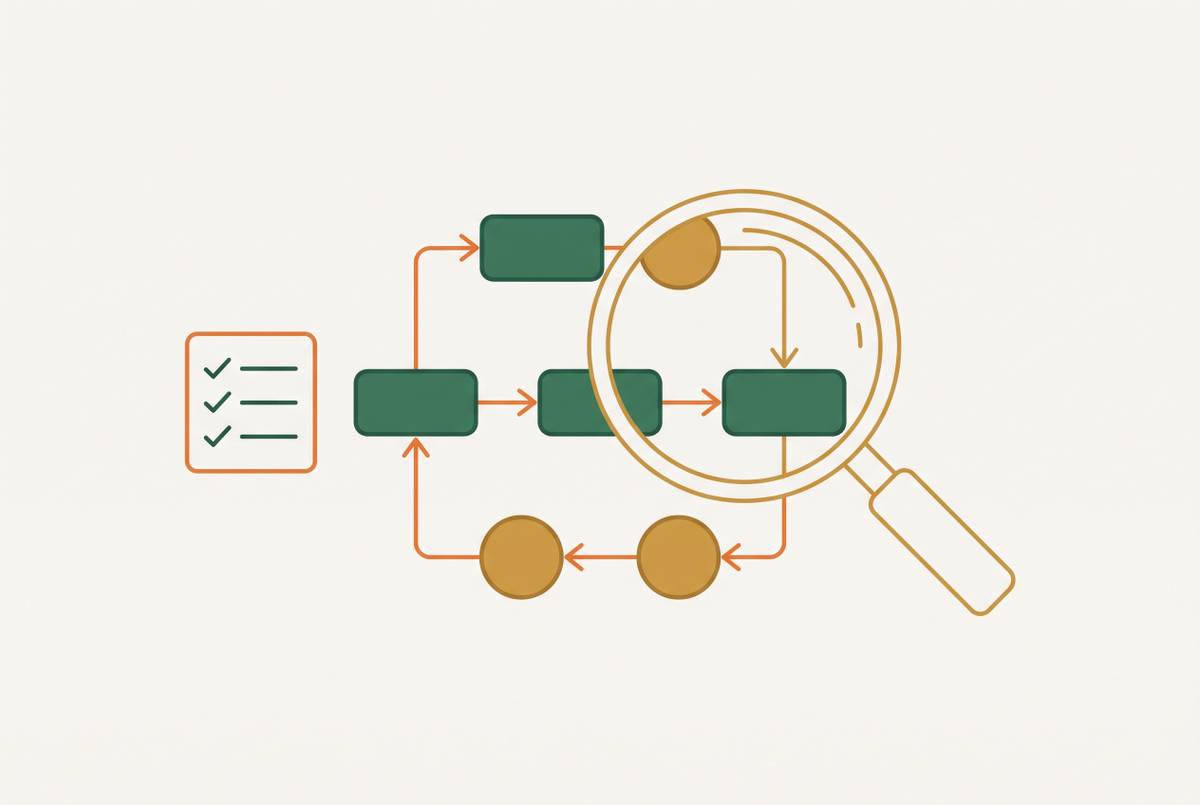
Any AI deployment built to actually work needs a structured audit of exactly where the process breaks today, a workflow-level examination of where decisions stall, where data turns inconsistent, and where exceptions fall out of the governed path entirely, rather than a technology assessment or a data maturity survey. That audit has to start with one specific, painful process rather than a platform strategy or a broad transformation roadmap, and the right opening question is simple: show how this process runs today, and where it hurts. Four failure seams deserve direct examination in any retail process audit. Data timing mismatches show you where downstream systems get updates on a different cadence than the upstream events that triggered them, and what decisions get made on stale data as a result. Approval routing gaps show you where exceptions leave the governed workflow and land in email, spreadsheets, or someone's individual judgment, and how often that happens on an ordinary operating day. Cross-system handoff points show you where data has to move between two systems running different integration patterns, and what breaks or gets dropped at that handoff once the system is under load. Decision authority mismatches show you where people make decisions without the authority or the real-time information they need to make them correctly. Exception-based execution, anticipating and preventing problems before they affect operations, is one of three operational capabilities that distinguish retailers who have overcome supply chain complexity. It only works if exceptions can be identified and routed in the first place, so the workflow has to be governed before AI is layered onto it. Supply chain compliance deployments show the same sequencing at work: AI tools for supply chain traceability are moving from competitive differentiator to regulatory requirement in apparel and related categories, and the retailers deploying them successfully already had a process, even an imperfect one, for capturing sourcing, labor, and provenance data before AI arrived. The AI accelerates a process that already existed. Walmart's delivery app offers a direct caution on this point: an item-mapping feature meant to help delivery workers navigate stores instead slowed some workers down and reduced their effective earnings, a clear case of an AI-assisted workflow change deployed without ground-level testing of how it would interact with the actual operational process it touched. None of this diagnostic work is a one-time readiness checklist. AI operations in retail belong in the category of enterprise process engineering, not point automation, and the audit's real output is a ranked list of what to rebuild first, with the sequence of that rebuild mattering as much as the diagnosis itself.
The rebuild sequence and whether the AI deployment holds
AI deployments that deliver durable operational change and those that stall or regress afterward are not separated by the sophistication of the technology involved. They are separated by whether the process was rebuilt before the AI was asked to run it. The high-performer finding holds consistently in one direction: organizations attributing meaningful margin impact to AI fundamentally redesigned their workflows rather than simply adding AI tools onto existing ones, and this group remains a small minority of deployers overall. C.H. Robinson's logistics deployment shows what bounded, well-sequenced AI looks like in practice: a transactional freight-quoting agent operating on a well-defined, narrow process, proprietary data in, customer-specific quote out, where the process was already structured before the AI was applied to it. Quote coverage and response time improved dramatically because the AI was executing a process built for it in advance, not inheriting one still in disarray. Retail enterprises are shifting from rule-based automation to agentic architectures because legacy automation cannot handle exception volume in complex workflows, but that shift raises the stakes further: agentic systems act without waiting for human review at each step, so a broken process runs farther and faster before anyone catches it. The move away from safety stock as a resilience strategy toward tech-optimized inventory approaches signals where the next failure will land if the sequence is wrong: that shift only works if the underlying data is trustworthy, and that trust is what breaks first in fragmented operations. If retailers make this shift before they resolve their data architecture, they trade one risk for a larger one. The rebuild-first principle does not demand a long timeline. The right approach produces a live, AI-first process in weeks, not quarters, and a long timeline is itself a signal that the wrong method is in play, usually a platform strategy or a broad transformation roadmap standing in for a focused rebuild of one specific, painful process. Sustainable ROI requires moving past adoption driven by fear of being left behind. WPP Enterprise Solutions finds that 64% of digital transformations start without a clear roadmap or end goal; leadership has to treat AI as a holistic business transformation that fortifies underlying data systems, invests in change management, sets clear guardrails, and builds governance that scales with the operation.