Defining Done in an AI-First Process Rebuild
Without clear completion criteria, AI rebuilds quietly slide backward.
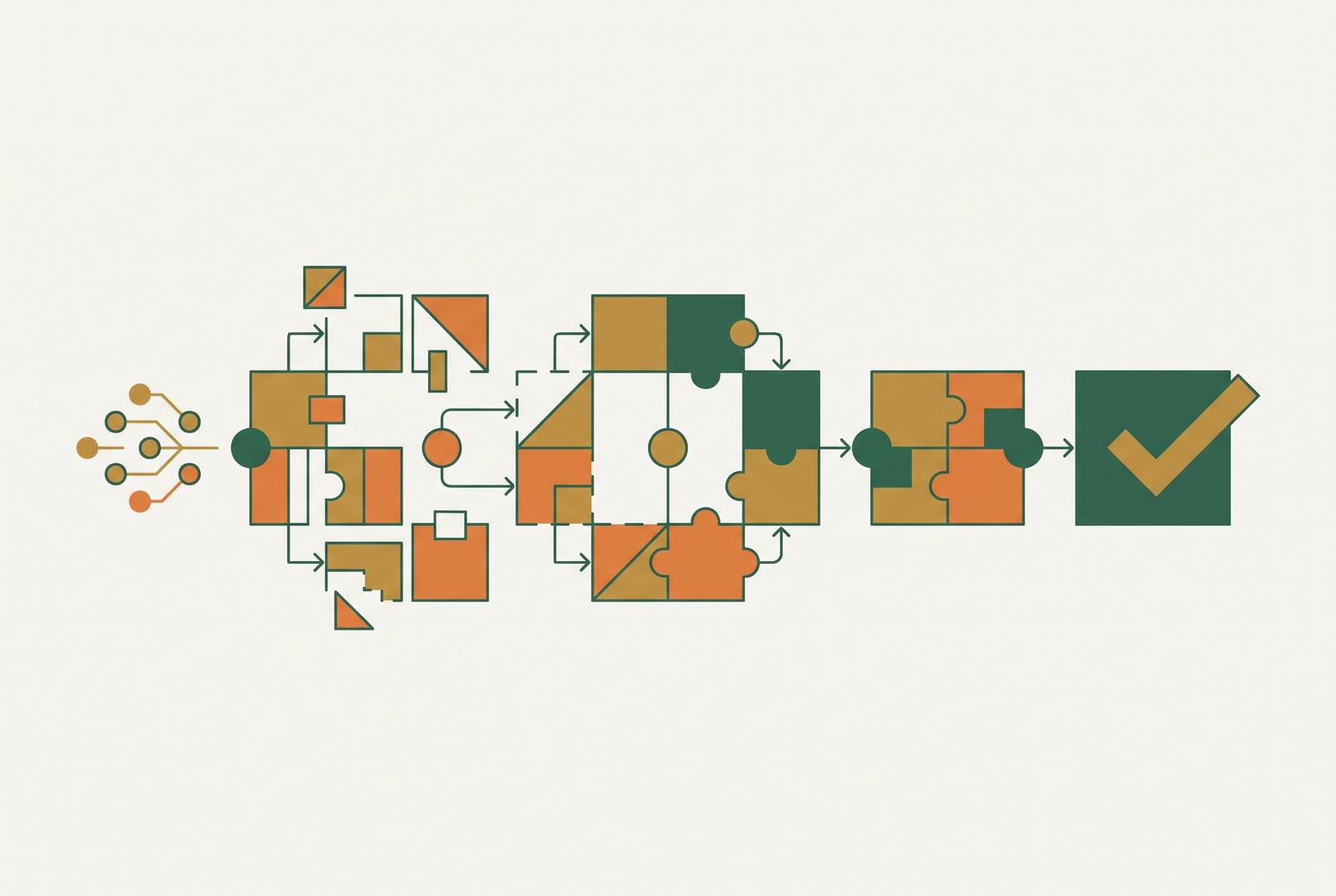
A pipe-spool fabrication error, caught weeks after the drawing was approved, used to mean days of manual cross-referencing against 3D models, procurement records, and the construction schedule before anyone could say what went wrong or what to do next. That delay, not the error itself, is what an AI-first rebuild is supposed to eliminate. But the moment a company flips the switch on the system meant to close that gap, it faces a question with no obvious answer: what does finishing this rebuild actually look like?
Defining "Done" in an AI-First Rebuild
A standard IT deployment has a clean finish line. The system goes live, the users get trained, the legacy platform gets switched off, and the project closes. An AI-first process rebuild has no equivalent signal, because the value of an embedded agent depends entirely on how it behaves inside a live decision flow, something no one can fully verify before go-live. McKinsey's 2026 analysis of the architecture, engineering, and construction sector draws a sharp line between two very different end states: layering AI on top of existing work, and redesigning the work itself so that agents retrieve information, draft outputs, flag risks, and route decisions while humans retain judgment, accountability, and the trade-off calls. Those two end states need different definitions of completion, and most organizations never choose between them explicitly. They default to the vocabulary already sitting on the shelf: "go-live," "launch," "deployment," terms built for IT project management, where the system working as specified at a point in time is the whole test. Applied to a process rebuild, that vocabulary measures the wrong thing at the wrong moment, and it lets teams celebrate a milestone that was never the point.
AI Genuinely Embedded in the Decision Flow, Not Layered on Top
Whether a rebuild can ever be called done depends on one structural fact: does the AI agent sit inside the decision loop, or does it sit outside it, available but optional? A reporting tool, a dashboard, a recommendation engine that a person may or may not consult before making a call, these are additions to a decision process that remains exactly as it was. The decision still gets made the same way it always did; the AI just offers a second opinion nobody is obligated to take.
An embedded agent is different in kind, not degree. It is the step. Retrieving the relevant records, synthesizing them, routing the result to the right person, flagging what needs attention: these actions constitute the process itself. Without the agent, the process does not merely slow down; it breaks.
McKinsey's 2026 piece on the AEC sector describes exactly this state in practice. In the agentic model it outlines, agents compare a field image with the latest 3D model, engineering drawings, procurement records, and the construction schedule. From there they identify the likely cause of the discrepancy, draft routing options, check material availability, estimate cost and schedule impact, and recommend a path forward, all before a human makes a single decision. The human still approves the path. But the days of assembly work that used to precede that approval have been absorbed into the agent's own operation.
Deloitte's manufacturing survey, drawn from more than 140 manufacturers, points to the same underlying logic from a different industry. AI creates the most value precisely where processes carry high variability, many interacting parameters, and real operational consequences if they go wrong. Those are exactly the conditions under which a human, working alone, cannot reliably hold every variable in view at once, so embedded decision support turns from a convenience into a requirement.
Ambiguity About Completion Criteria Causes Rebuilds to Stall or Regress
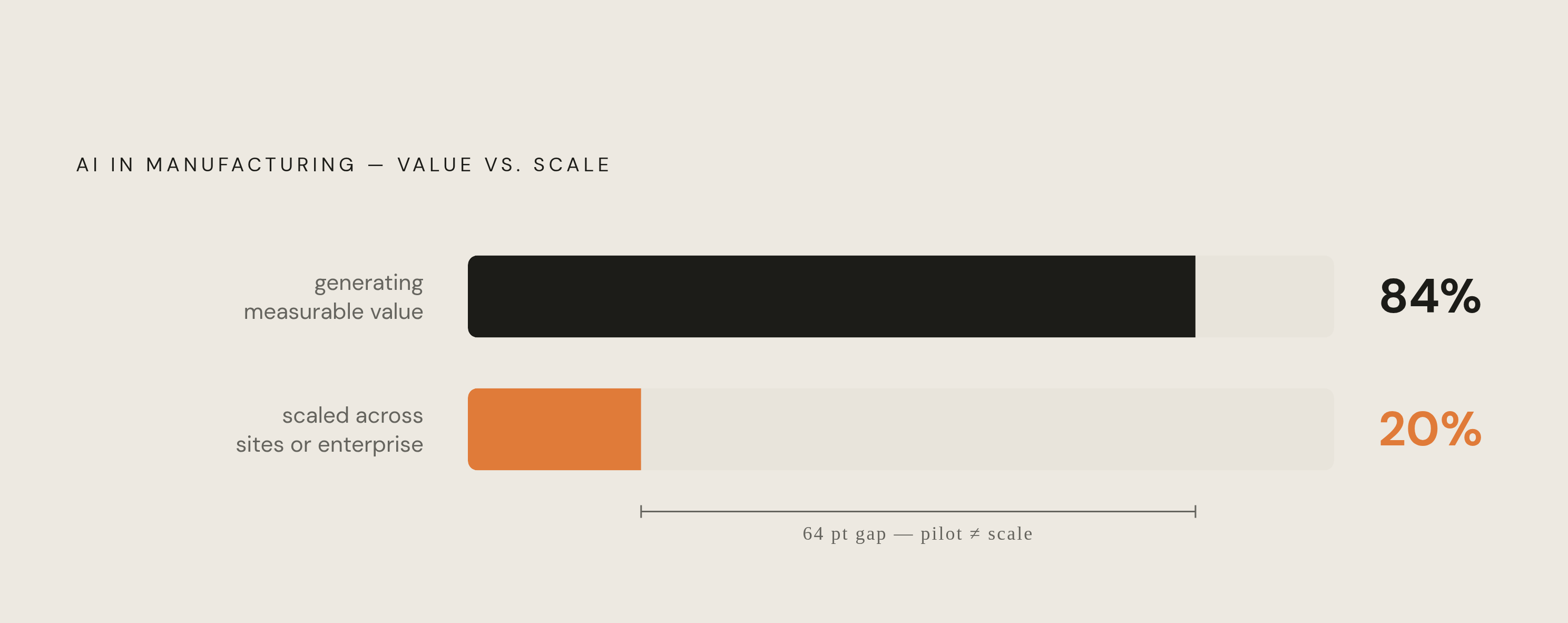
Teams without explicit, operational criteria for what a finished rebuild looks like have no shared signal for success, and without that signal, they have no way of noticing regression either. The scale of this gap is documented: Deloitte's 2026 manufacturing survey finds that 84 percent of manufacturers already generate measurable value from AI, yet only about 20 percent of use cases have been scaled consistently across sites or across the enterprise. Most organizations have proven that AI can work in a pilot. Far fewer have built the operational discipline required to sustain that performance once the pilot becomes the standard way of working.
Without criteria, a team treats go-live as the finish line, then watches small manual workarounds creep back in whenever the agent misfires on something unfamiliar. Each individual workaround looks reasonable in isolation: a person double-checks a flagged output, reroutes an exception manually, re-runs a calculation the agent already produced. Taken together, those workarounds slowly rebuild the old process around the agent instead of letting the process run through it.
Ambiguity about criteria also removes accountability. No one owns the definition of success, so no one is positioned to detect drift from it. Deloitte's survey lists the risks manufacturers associate with AI deployment: 79 percent cite operational disruption risk, 51 percent cite cybersecurity and data protection risk, 29 percent cite user acceptance risk, 27 percent cite compliance exposure, and 15 percent cite system or model reliability risk. Explicit, pre-defined completion criteria would surface these categories early, before they compound into a pattern. A rebuild that looked successful in its first months can, a year later, look indistinguishable from the process it replaced, with the agent still technically running in the background but no longer governing a single decision that matters.
The first criterion: the rebuilt process produces outputs the old process could not, not just faster versions of the same outputs
A rebuild clears its first bar when it produces outputs that were structurally impossible under the old process, not simply faster versions of outputs the old process already managed. Speed gains are real and worth having. They are just not, on their own, proof that a rebuild has succeeded.
The construction example makes the distinction concrete. Under the old process, an RFI response took days of manual cross-referencing across drawings, procurement records, and the schedule. Under the rebuilt process, that same request yields a consolidated view of options, trade-offs, and downstream implications within hours. It is a richer answer that holds constraints simultaneously in a way the manual process never could, not simply the old answer delivered sooner.
Deloitte's 2026 survey shows where this kind of qualitative shift is most available. For discrete manufacturing, the highest-impact domains are assembly at 22 percent, primary shaping at 21 percent, and changing material properties at 19 percent. For process manufacturing, the standout is chemical and physical transformation at 32 percent. These are domains defined by high variability and many interacting parameters, the exact conditions under which the old process could never hold every variable in view at once. An agent that does hold them is producing something categorically new, not something merely quicker.
The test for this criterion is simple to state: did this output exist, in any form, before the rebuild? If the answer is yes, and the only change is how fast it arrived, the process has been optimized rather than rebuilt. This criterion belongs at the start of the project, defined as the target state before any code is written or any workflow is redesigned. A rebuild that cannot specify, in advance, what new output it is aiming to produce has not been scoped to deliver a real capability change.
The second criterion: the AI agent governs the process under the conditions that caused the old process to fail
A rebuild is not finished until the agent has been tested against the specific conditions that broke the process it replaced, because those conditions are where the rebuild's value is supposed to live. Deloitte's 2026 survey confirms this directly: AI creates the most value where processes carry high variability, many interacting parameters, and material operational consequences. Those same conditions are also where a poorly validated agent is most likely to misfire.
A useful parallel comes from how construction schedules are built: a schedule that accounts for capital availability and equipment delivery but ignores crew availability for energization is not a complete schedule, no matter how clean it looks on paper. The same standard applies to a rebuilt process. One that performs well under ordinary load but breaks under the same exception conditions that broke the old process has not actually been rebuilt. It has been replicated with newer tools.
Testing for this criterion means running the rebuilt process against historical failure cases, the procurement delays, inspection gaps, and data-quality failures that produced wrong or missing outputs under the old system. If the agent handles those cases, the criterion is met. If a human has to quietly step in and compensate, it is not, no matter how well the system performs on a normal day. The goal here is not perfection. An agent that fails visibly and recoverably under a hard case is doing its job. One that fails silently, in the same way the old process did, has not changed anything that matters.
The third criterion: humans in the process are making different decisions, not the same decisions with a new interface
A rebuild has changed the interface, not the process, if the people running it are still making the same decisions they made before. That distinction is the clearest test of whether done can honestly be declared. McKinsey's analysis states the goal directly: when agents take on routine tasks, people can turn their attention to pricing, risk, and the other judgment calls that require real human discretion and create competitive advantage. The test is whether that shift has actually happened, not whether an agent now runs somewhere alongside decisions that have not moved.
This criterion is harder to measure than throughput or cycle time, because it is behavioral rather than numerical. It calls for direct observation of how people actually work with the agent under live conditions. In a process that has genuinely changed, humans spend more time on decisions that require cross-functional trade-offs and real accountability, and less time on decisions that were, underneath the paperwork, just information assembly disguised as judgment. That second category consumed most of the old process's time, and shrinking it is the point of the rebuild.
The clearest failure signal here is an agent that produces recommendations humans routinely override without ever engaging its underlying reasoning. That pattern means the agent is sitting next to the decision rather than inside it, and the rebuild, whatever its dashboards show, is not done.
The fourth criterion: the process audit would find the new process, not the old one, running in the field
The only reliable way to confirm a rebuild is finished is to audit what is actually happening in the field, not what the process documentation says or what the system logs claim. Documentation describes an intention. Field behavior describes reality, and the gap between the two is where rebuilds most often quietly regress.
A field audit of a rebuilt process asks a short list of direct questions. Is the agent being used at the actual point of decision, or is a parallel manual process still running beside it out of habit? Are the agent's outputs the basis on which decisions get made, or are they being checked against a separate manual calculation that nobody has retired? Are exceptions routed through the agent, or quietly routed around it by people who have learned it's easier that way?
Deloitte's survey found that 29 percent of manufacturers cite user acceptance risk as a post-deployment concern, trailing operational disruption risk at 79 percent and cybersecurity and data protection risk at 51 percent. That ranking is itself informative: the gap between a documented process and the process actually running in the field is a known, recurring problem across the industry, not an unusual edge case limited to one company's rollout. The implication for how done gets declared is direct. The process audit is the post-launch verification that confirms a rebuild has actually succeeded, not a pre-launch checkbox. A rebuild that has never been audited under live operation has not been declared done. It has only been assumed done, which is a very different thing.
Defining Completion Criteria Before the Rebuild Starts
Every criterion described above points to the same practical conclusion: completion criteria have to be defined against the specific failure modes of the process being replaced, and the process audit that precedes a rebuild is also the natural source of those criteria. Start with the process as it actually runs today. Where does it produce wrong outputs? Where does it produce outputs too slowly to be useful? Where does it produce no output at all, forcing someone to step outside the system to get the work done? Every point where a human currently compensates for a step the process cannot handle is a candidate completion criterion. The rebuild is done, on that specific point, once the agent handles that step reliably under live conditions.
Data quality deserves its own line item in this exercise. Deloitte's survey finds that data availability and quality issues rank fifth among cited implementation challenges, behind high implementation costs at 43 percent, lack of technical expertise at 35 percent, resistance to change also at 35 percent, and regulatory or compliance concerns at 34 percent, with data issues themselves at 30 percent. A fifth-place ranking does not mean the issue is minor: one practical completion criterion for any data-intensive process should be whether the agent can operate on data as it actually arrives, messy, incomplete, late, rather than on the clean data it would receive in an idealized test environment.
Scope discipline matters as much as the criteria themselves. The first rebuilt process in any organization should be narrow enough that its completion criteria can be verified within weeks, not quarters. A sprawling transformation roadmap cannot be declared done, because it was never given a bounded end state to reach. A single, specific, painful process, with four to six explicit criteria attached to it, can be. Terminal Use, an AI-first operations firm that rebuilds department workflows end to end for construction, logistics, manufacturing, and retail companies, begins every engagement with exactly this kind of scoped process audit before any agent is deployed. Those criteria should be written down before the rebuild begins, shared with the team that will actually run the new process day to day, and revisited at the post-launch field audit described above. If the criteria cannot be written down in advance, the process has not been scoped narrowly enough to rebuild responsibly, and no deployment date will fix that.