One Painful Process Is the Whole Strategy for Plant AI Adoption
Plants should rebuild one recurring, measurable process end to end.
Plant AI adoption requires choosing one recurring, measurable operations problem and rebuilding the entire process around it, including its data, decisions, handoffs, and exceptions. For asset-heavy industries, committing to that one process is the full adoption strategy, with no need to choose enterprise software afterward.
Why plants keep running pilots instead of shipping AI into production
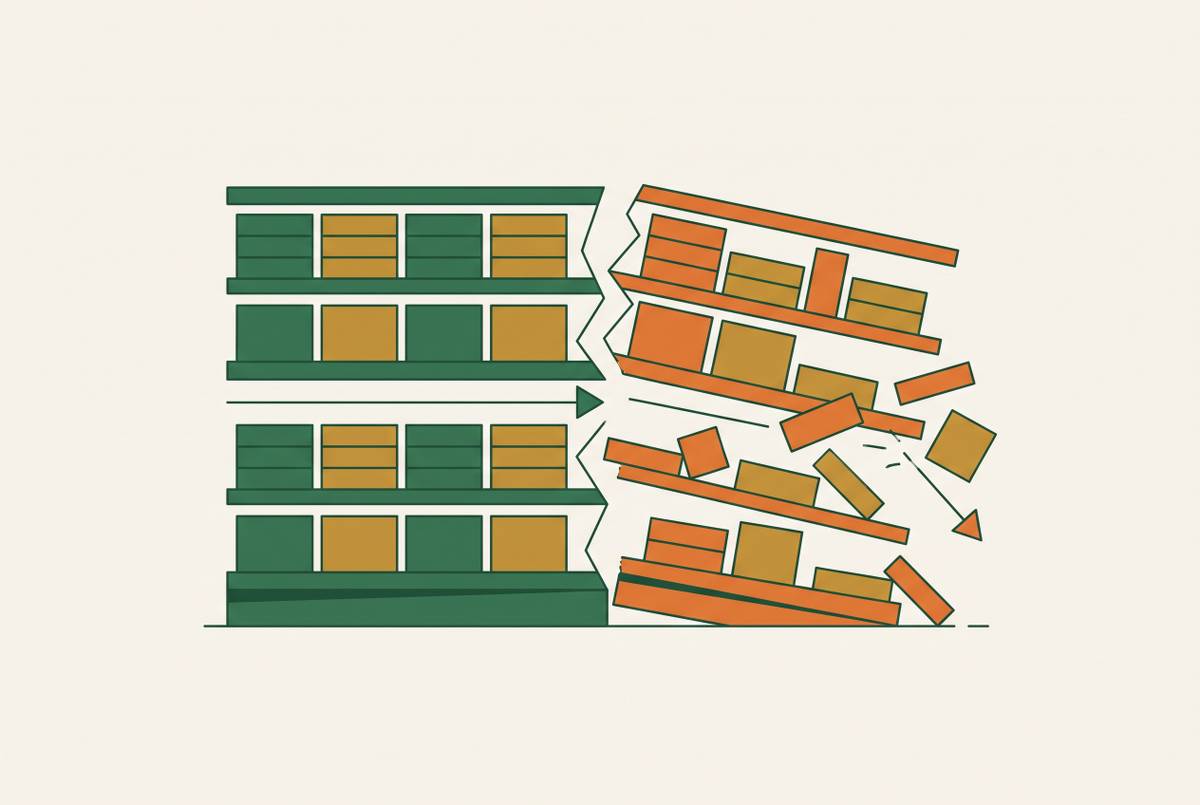
An operations leader has run pilots, seen promising results, and still cannot point to a live process that depends on AI. The demonstrations work. The daily operation remains unchanged because nobody has resolved what happens when the pilot crosses a departmental boundary, encounters an exception, or needs someone to act on its output.
This is a sequencing trap. Plants build an AI strategy before establishing operational proof, while layering AI onto workflows designed for sequential, siloed work. Those workflows may have been digitized over decades while decisions still pass between planning, production, supply chain, and workforce teams in the same way. AI can connect those activities in real time, but that connection produces little value when the authority to act remains fragmented. The pilot stops at the boundary, leaving the organization without the internal credibility needed to commit to production.
What keeps a pilot a pilot — the four failure modes that prevent graduation to production
The cascade begins when a team treats the pilot as an experiment. A team can walk away from a contained experiment without deciding who is responsible for how the process turns out. So someone else is left to work out the escalation paths later. By contrast, a production commitment includes the unified data layer, process orchestration, and governance needed to run the work. Those decisions are part of the project.
That missing ownership creates the autonomy gap. AI handles routine cases, but cases requiring judgment have no structured route to a person authorized to resolve them. Exceptions then remain unresolved or demand frantic manual intervention. At that point, the people responsible for production must recover the process themselves, eroding the trust that the pilot was supposed to establish.
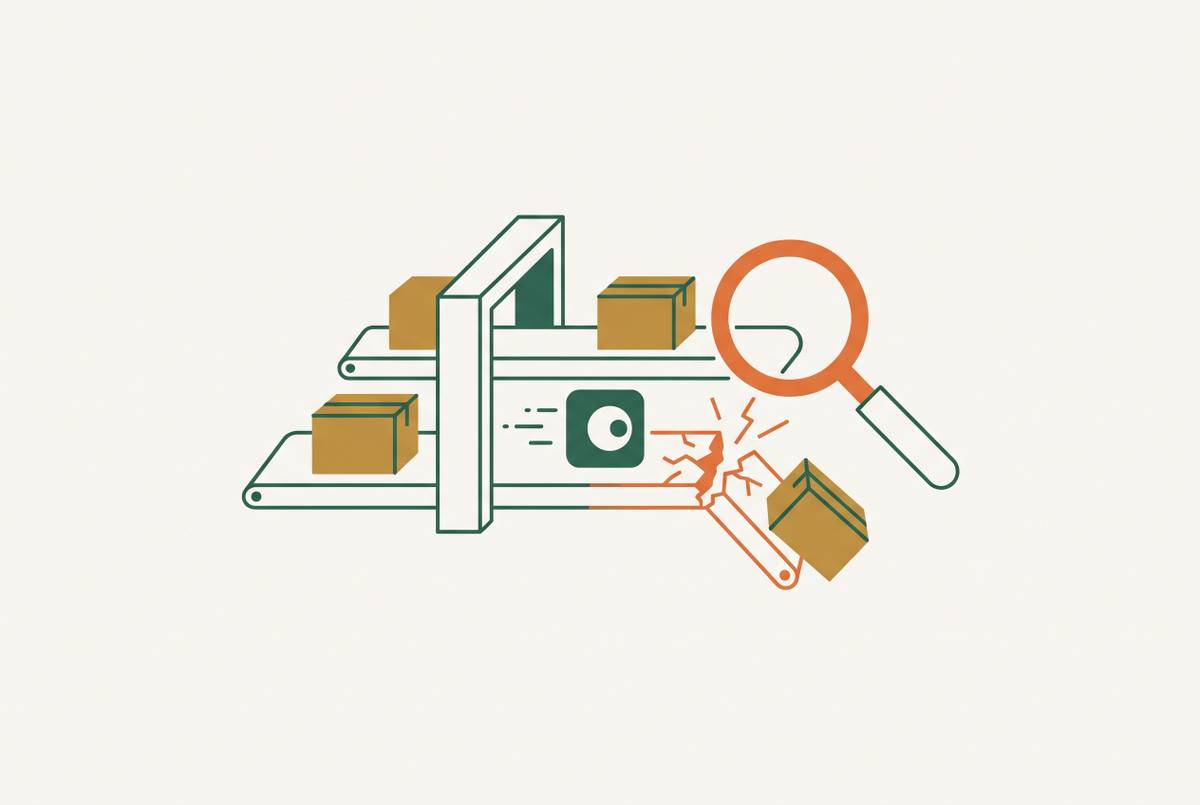
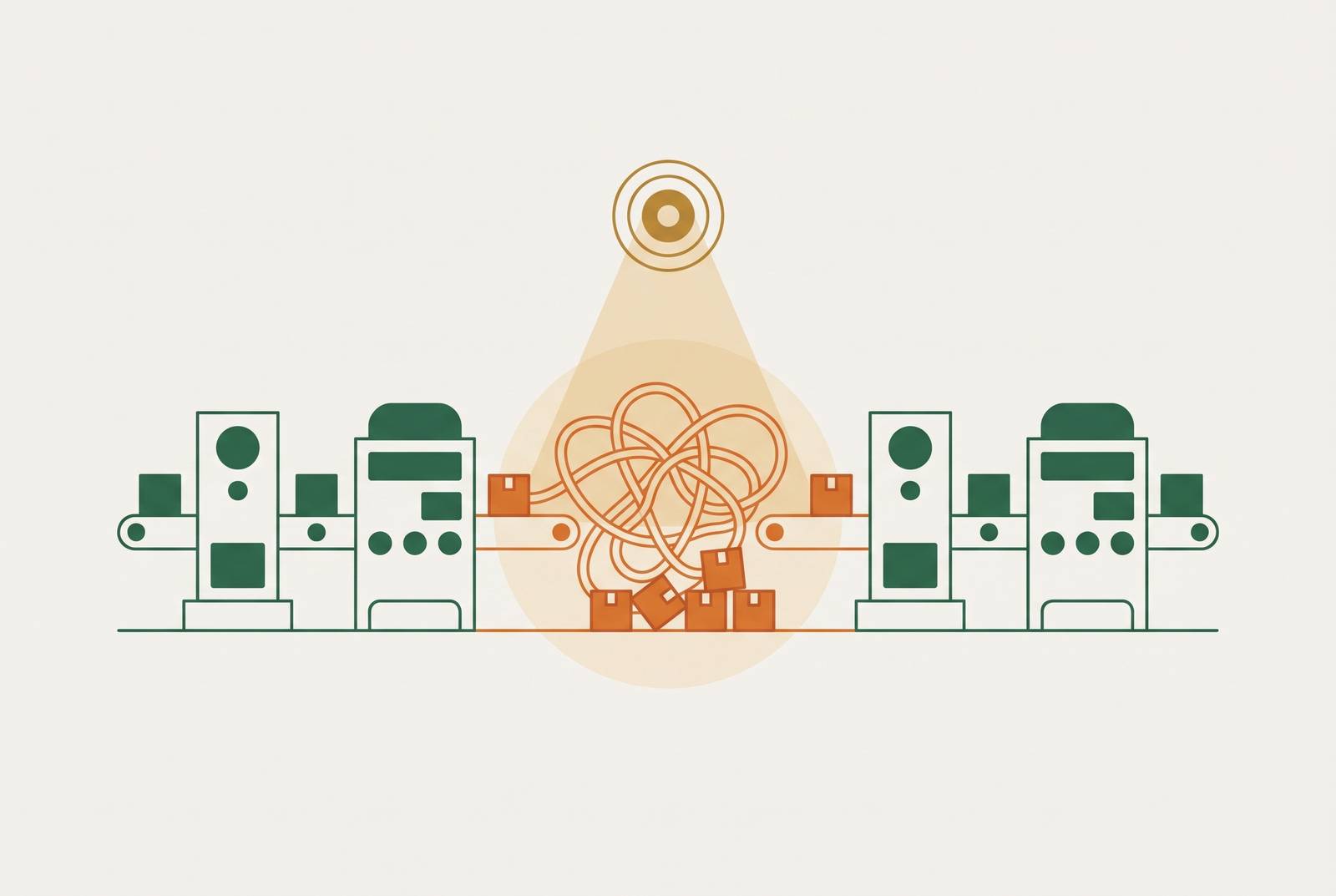
The gap becomes more damaging as handoffs accumulate. Even when each step works well, the end-to-end process can fail because each added dependency is another place where something can go wrong. Manufacturing operations often have long chains of these dependencies, but tests rarely cover the whole chain. Production also exposes the fourth failure mode, which is unreliable data beneath apparently sound results. Reliable machine states, standardized stop and scrap codes, and clean master data support useful decisions, while partial logging and free-text comments weaken them. Together, these failures make the pilot trap self-reinforcing, so better tooling alone cannot break it.
Why automating a painful process differs from rebuilding it, and why the difference determines outcomes
The electrification parallel makes the distinction clear. Replacing the source of power is different from redesigning the work to exploit what the new source makes possible. AI creates the same choice between fitting a new capability into an inherited workflow and changing the workflow itself. AI can help teams learn faster, change decisions as conditions change, and coordinate work more closely than a reporting layer can. The opportunity lies in changing how work is organized.
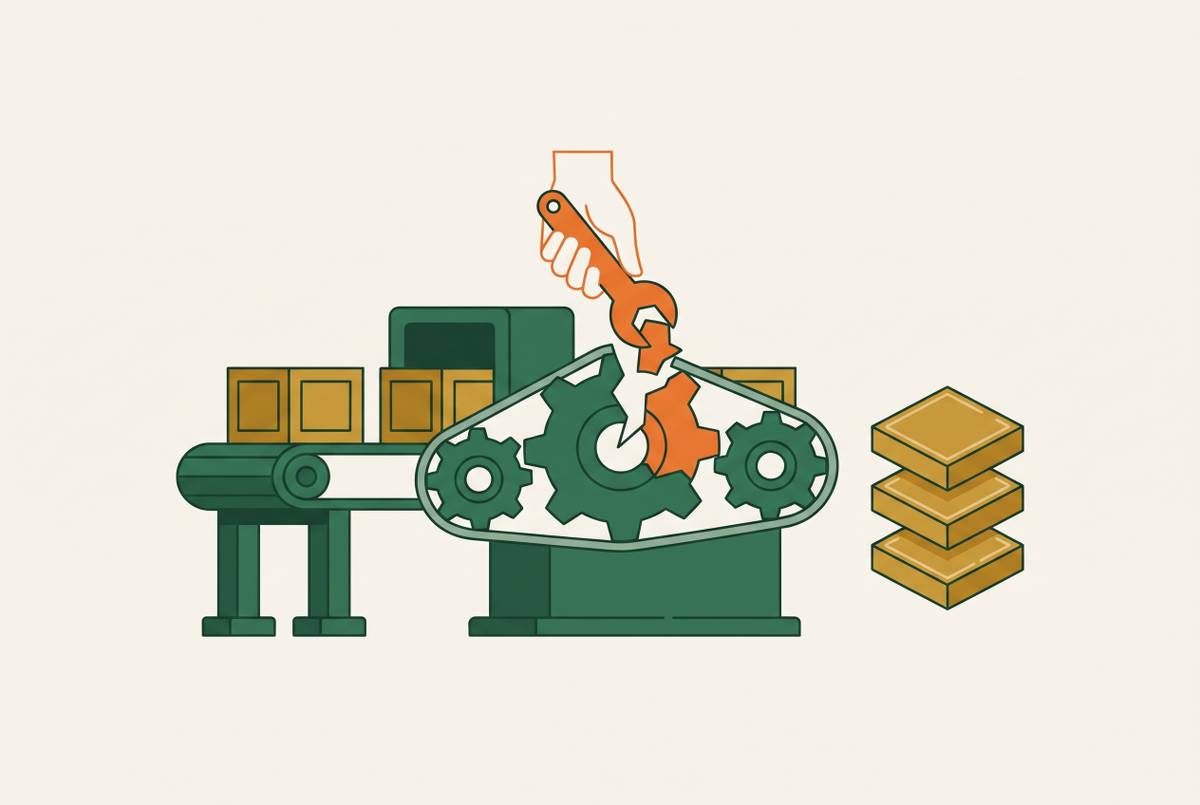
Automation makes a step faster without always asking why it is there. Redesign changes what happens there and removes steps that exist only because the old process required them. That changes the question a team brings to the work. Rather than asking where AI can be inserted, the team asks what AI must understand about the process to help reshape it. A team can keep the scope narrow and still redesign the process fully if it covers everything needed for the operational outcome, beyond a single task.
The J-curve includes a measurable dip before the benefits arrive, and that early friction is easily mistaken for evidence that AI does not work in the plant. Teams that expect uninterrupted improvement may retreat to the old process precisely when the redesigned one needs sustained commitment. Teams need to establish tolerance for that dip in advance, while retaining the success criteria needed to judge the eventual outcome.
How do you choose one plant process to fix with AI without buying a whole platform?
The selection decision begins with operational pain. A rigorous operations partner looks for a failure that recurs, can be measured, and burdens the people who run the process every day. The most visible project is not necessarily the right one. Downtime, scrap rate, schedule slip, and handoff delays give the plant ways to track progress because it already knows what better results would look like. A project that looks valuable mainly in a presentation to leadership has little of that grounding in the plant’s work.
Operators and supervisors need a reason to use the redesigned process beyond an instruction to adopt AI. Recurring difficulties in their own work provide that reason. Selection also requires enough structured data to support the proposed decisions, rather than a hope that the model will compensate for missing operational discipline. Shoplogix’s 2026 plant guide says plants can get more from the same AI capability when they have reliable machine states, standardized loss codes, and clean master data.
A process audit should then compare the declared workflow with how the work actually happens. The gap is diagnostic. Disconnected evidence, conflicting policy versions, and decisions resting on tacit knowledge can reveal where the process breaks down. The audit should document each handoff, its owner, and what happens when it fails. This exposes whether the candidate can be rebuilt end to end or merely improved at one point.
Some candidates should be rejected despite substantial pain. A process spanning too many functions can require adjacent systems to change in parallel, defeating the purpose of a bounded commitment. Fundamentally unreliable data is another reason not to begin there. The plant guide says many times when AI disappoints, it reveals flaws in data quality more than in model performance. The right first process combines significant pain with a workable boundary and enough dependable evidence to support a complete rebuild.
What a complete single-process rebuild actually looks like in practice
Workflow documentation, escalation paths, and success criteria establish what the system is expected to do and where human judgment takes over. Deployment follows those decisions. The rollout is incremental, with one area tested against the chosen metric and standardized before extension. This is a minimum viable transformation.
Genentech’s gRED Research Agent illustrates how changing the structure of work can produce gains beyond accelerating an individual task. Built on Amazon Bedrock, the single agent retrieves information from multiple sources, including PubMed and internal databases, and synthesizes findings into cited summaries. Research synthesis timelines improved by approximately 90% through work running in parallel across many threads.
That example also establishes an important architecture boundary. The agent was built as a single agent, with plans to move toward a network of specialized sub-agents differentiated by data domain. It should not be described as an already deployed network with separate functional agent classes. In a plant rebuild, retrieval and synthesis, exception detection, and decision support may require distinct responsibilities, but those responsibilities should follow the process design.
The same distinction applies when AI informs physical operations. Maintenance can shift from fixed schedules toward predictive models, while quality control can move from finding defects after production toward recognizing the process conditions that precede them. These are changes in when and how decisions happen. They cannot be achieved simply by placing an AI-generated report above an unchanged workflow. A complete rebuild connects the insight to the operational decision and defines how exceptions return to human judgment.
Why operators and supervisors are the real adoption constraint — and how rebuilt processes address it
Even a well-designed technical system fails if the people responsible for acting on its output do not trust it. Operators and supervisors therefore need to help design the changed process. Their participation is an operational requirement. They must understand where the recommendation fits into the work, what judgment remains theirs, and how to handle a case the system cannot resolve.
A rebuilt process changes the point at which support appears. Operators receive recommended settings, drift warnings, and pattern recognition where they act. Maintenance teams receive priorities based on predicted risk and production context. Planners get confidence ranges and exception alerts in place of deterministic schedules that cannot keep up when conditions change. The plant guide describes AI as a sharp assistant rather than an autonomous operator, with humans retaining decisions, tradeoffs, and sign-offs.
Choosing a painful process makes that way of working easier to take up because the team already wants the problem solved. Relief creates a reason to engage with the output. Each successful rebuild can then strengthen data habits and trust, giving later work a firmer base than the first pilot had. That confidence comes from useful decisions inside daily routines.
The rebuild also changes the skills the operation needs. People who understand both equipment behavior and the data structures that represent it become essential translators between the floor and the model. Their role connects physical events to evidence a system can learn from. Basic data literacy also becomes part of everyday work, as people learn to question an AI insight and read a model-driven dashboard. Those skills belong beside the ability to interpret an OEE report, rather than in a separate AI function detached from production.
Why the single-process commitment is the full adoption strategy, not the first step toward one
A rebuild that works does not require the plant to launch a platform strategy. Treating it that way recreates the original sequencing trap, with broad architectural ambition again placed ahead of a specific operational need. Production proof is evidence that disciplined process selection, complete redesign, and sustained ownership can work.
The completed process already produces assets that later work can reuse. Structured logging, standardized codes, and an event taxonomy give teams a way to keep their data in order as they work. Escalation paths, agent authority limits, and observability infrastructure provide a governance template. One operating team also has direct evidence that AI can help within its daily workflow. These assets support another specific process, but they do not remove the need to examine that process’s boundaries, data, and decisions.
The next selection therefore uses the original tests. It identifies the next recurring pain, names its owner, defines how failure will be measured, and establishes whether the data can support the work. Depth earns expansion. Leadership may want faster rollout, vendors may offer platforms, and adjacent teams may request the same results, but none of those pressures establishes readiness.
On Monday morning, the operations leader should identify the recurring failure that operators and supervisors most want resolved and open a process audit around it. That audit should establish the measure of failure, the handoff owners, the available data, and the exception paths. The commitment is to rebuild that process completely and prove it in production before taking on another. No parallel pilot portfolio is required. The strategy is the discipline of choosing and finishing the work, repeated only when the next process earns the commitment.