Why Asset-Heavy Operations Beat Platform Vendors by Starting With One Broken Process
Fix the broken process before deploying AI to automate it.
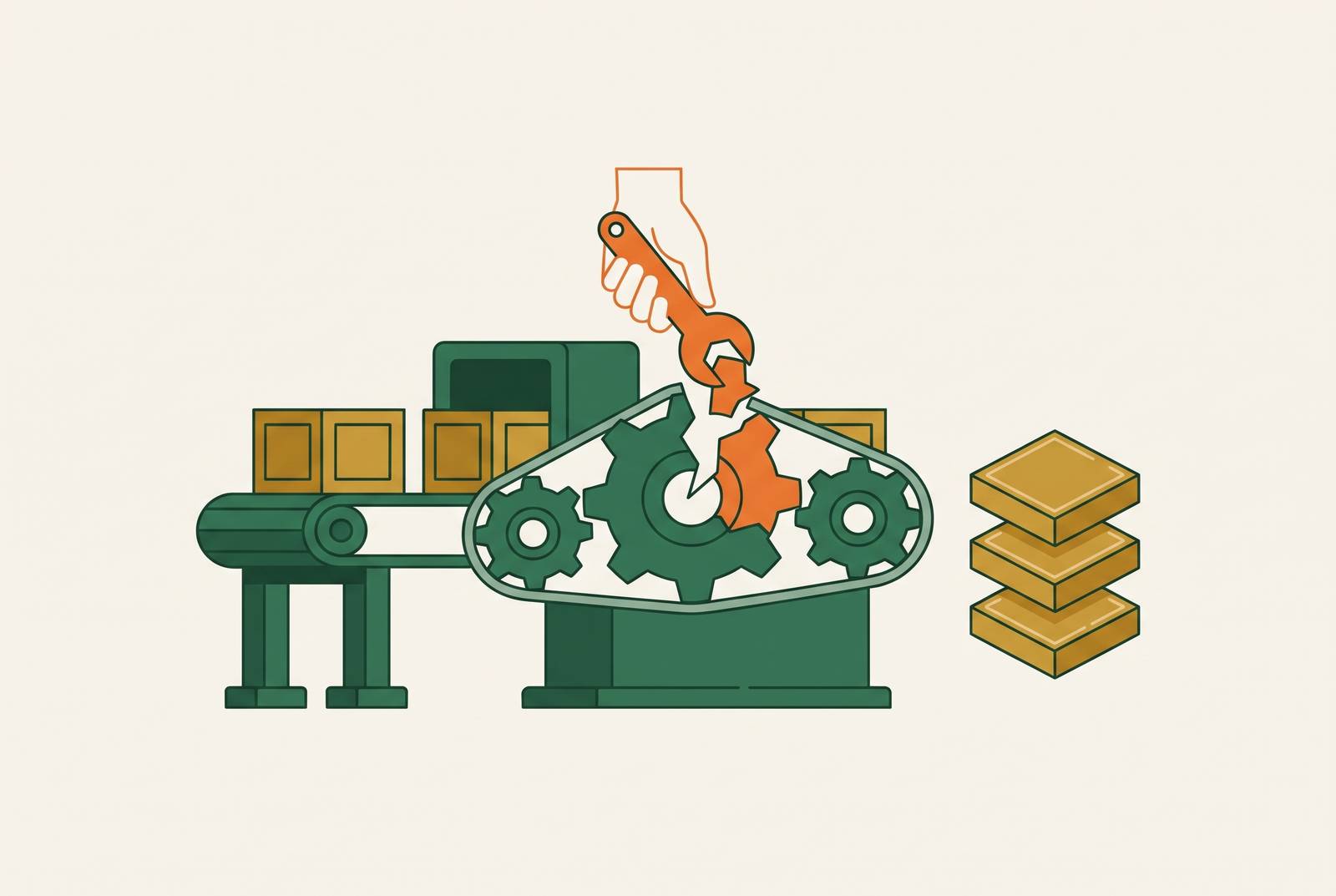
AI operations transformation in asset-heavy industries should begin with one broken process. The first step is to audit how that process runs, define a measurable success condition, and rebuild the workflow before introducing AI. This is the structurally correct starting point when performance depends on particular equipment, people, data, and operating constraints.
Why platform-first AI fails in physical operations before it starts
Factories that plugged electric motors into steam-era layouts saw no gains from the new capability. The gains came when the layout changed. AI runs into the same problem when it is added to workflows built around older tools, work coordinated by hand, and incomplete information.
A manufacturing plant is not a spreadsheet. Machines have idiosyncratic behaviors, operators have different experience levels, and maintenance histories shape what equipment can reliably do. Supplier delays, quality thresholds, and safety regulations further constrain the decisions available. A tool that reduces scrap in one plant can therefore be irrelevant, or even risky, in another.
Platform vendors sell horizontal capability, while physical operations need a vertical fit. That fit depends on how well AI supports the specific factory, equipment, people, and decisions within its scope. Better change management cannot substitute for this operational match, and a longer implementation does not establish it automatically. Before a platform can improve a process, the process must be understood well enough to determine what improvement requires.
How horizontal deployment hides its failure until after the money is spent
Horizontal deployment obscures this mismatch because its measures of success are often divided among departments. Engineering can report the platform uptime, product leads can report adoption, and vendors can report the transaction counts. Each measure may give an accurate picture of its own part of the deployment. None establishes whether the underlying business process became cheaper or better. The failure has no single accountable owner.
An automated pipeline can process transactions successfully while routing exceptions back into manual queues. If the business case omits the labor required to handle those exceptions, the declared savings exclude part of the work needed to finish the process. Computing charges can be similarly obscured when they flow to a central innovation fund, outside the department using the system. The pilot can pass every declared metric while making the process more expensive to run.
This is more than incomplete financial reporting. The chosen metrics let each participant claim the implementation worked without having to answer for how the process performed. By the time the full cost becomes apparent, money has already gone into a deployment whose success conditions never covered the complete process. An unaudited workflow makes that omission easier because its manual work and exception handling were never fully accounted for.
Industrial software consolidation offers a serious counterargument. Schneider Electric’s agreement to acquire PTC, its proposed acquisition of Cognite, and its existing ownership of AVEVA support the case that platforms can address data fragmentation at scale. However, vendor-layer integration does not resolve process-layer fragmentation when an operator has not established which workflow breaks first or why.
What scoping discipline actually looks like when it works
Scoping discipline means starting where the pain is specific enough to define a success condition. A useful scope identifies the workflow, its operational problem, and the person accountable for the result. That boundary makes performance open to examination. Narrowness serves a precise purpose in production. It limits what must be understood and demonstrated before the system can be trusted.
JPMorgan Chase’s Contract Intelligence (COiN) system had a defined task: to analyze commercial loan agreements. Its starting point was one painful process rather than a broad instruction to transform operations. The system went into production with that scope. Although loan analysis is not a physical operation, the example shows the discipline of making the task specific before making the deployment ambitious.
CHI Software found opportunities for automation across several departments but carefully chose which to put into production, with one owner in charge of each initiative. The software development firm tied those initiatives to operational problems identified with the people performing the work. This establishes that each initiative needs a coherent problem and ownership boundary, even when several proceed.
The 2026 Roadmap on Artificial Intelligence and Machine Learning for Smart Manufacturing frames the industrial deployment challenge as trustworthy, explainable, and reliable operation in high-stakes environments. A broad mandate leaves too many operating conditions and responsibilities unresolved to verify them across the rollout. A specific success condition makes production deployment possible because it establishes what reliable operation must mean for the work being done.
Why the process audit comes before the solution, not after
Selecting that first process requires a method for directly examining how work actually happens. In the workflow audit, internal business teams map the manual steps, repeated work, bottlenecks, and tools already in use. The people performing the process help identify its real break point. That distinction is essential to useful scoping. Otherwise, a neatly bounded project can still address the wrong problem.
Data readiness belongs inside this diagnosis, before platform selection. Factory equipment may lack sensors, historians may use inconsistent tagging, and production records may remain on paper or in spreadsheets, without a machine-readable version. These are constraints on what a deployment can do. A polished demo does not expose them. Vendors that omit the readiness conversation leave buyers without a sound basis for judging implementation timelines.
The audit must also distinguish the cost of the process from the performance of its individual tools. A bottleneck can sit between steps that each seem efficient on their own, while people may still do repeated work by hand outside the planned automation. Mapping the actual workflow brings those connections into the scope of the decision. It also exposes where new technology is being forced into legacy ways of working that need redesign.
The lesson for practitioners is to identify a process with a clear owner, a measurable cost, and a failure mode everyone involved recognizes. Direct observation supplies the evidence that a vendor demonstration cannot. Only then can the solution be defined around the work instead of the work being fitted around the solution.
Construction scheduling and energization readiness as the clearest case of a broken process hiding in plain sight
Construction exposes the gap between a visible schedule and an executable plan. Teams need to know whether the next work package is actually ready to proceed, but platform-level AI deployments largely leave that process unresolved. Scheduling is both a high-value target and a neglected one. Sixty percent of contractors report no plans to use AI or automation in scheduling, so plans for adoption fall far short of what the work needs.
Predicting that work may be late does not establish whether it can begin. Readiness depends on information distributed across schedules, procurement, labor, quality, field reports, and project documents. A process-specific intervention brings that fragmented evidence to bear on the next critical work package. Its output is an evidence-based readiness signal, identification of the specific missing condition, and a connection to the accountable owner. The target is a decision about executable work.
Energization readiness makes this distinction particularly clear. The useful scope is the process of determining whether the required conditions are in place, rather than a general ambition to make project management more intelligent. That scope sets what the data-cleaning work needs to achieve. It also gives ownership a concrete meaning because a missing condition must be connected to someone responsible for addressing it.
Established construction uses of AI, including estimating, takeoff, computer-vision safety monitoring, and progress tracking, depend on structured field data first. Readiness work faces the same prerequisite. Cleaning fragmented data can do especially much to help when it shows whether critical work can go ahead. The process audit thus shows which decision needs support and which information must be made usable before AI can help with it.
Why AI agents fail in production when the surrounding process is not rebuilt first
A narrow scope can pinpoint the right problem in an existing workflow while leaving what causes the failure unchanged. Automating that workflow then makes its failures occur faster and at greater cost. This is the next risk for technically capable teams. A successful test establishes less than reliable operation within the organization that must govern and support the agent.
Production failures fall into five categories described in the brief’s deployment evidence. Governance gaps allow an agent to act outside policy, while transparency gaps prevent reviewers from reconstructing its actions. Coordination gaps occur when agents fall out of step. Safety gaps allow untrusted content to contaminate trusted reasoning. Plateaued improvement appears when deployments stop improving despite model upgrades.
The last category is especially revealing because the agent need not behave incorrectly for the system to fail. The surrounding processes, incentive structures, or human oversight capacity may be unsuitable for production deployment. In that situation, a better model does not repair the organizational constraint.
The practical consequence is that process redesign must address the conditions under which agent actions can be governed, understood, coordinated, and reviewed. The roadmap’s requirements for trustworthy, explainable, and reliable operation become testable only against clear operating conditions. A legacy workflow that leaves responsibility or oversight unresolved does not provide that basis. Customization can improve the tool without repairing the system in which it operates.
This extends the purpose of the audit beyond selecting an attractive first use case. The audit must establish what needs to change inside that process before an agent can run reliably. Its findings may concern data, manual steps, ownership, or the capacity for human oversight.
How to start AI in a plant without buying a whole platform
For operations leaders, the practical starting point is to examine one painful process with the people who perform it. The audit establishes the owner, measurable cost, recognizable failure mode, and data constraints. From there, the team can define the success condition and the process changes needed to meet it.
Useful starting points include guidance customized to operators’ experience and tasks, or support for supervisors making decisions across quality, maintenance, and schedule data. Each begins with a specific decision or difficulty in the work. Both can proceed without an order to adopt every AI capability. The appropriate boundary is the process that can be understood, rebuilt, and assessed against a clear operational result.
The first rebuilt process can reach live operation within weeks rather than waiting quarters for a broad transformation program to take shape. Speed still requires readiness work and is evidence that the initial scope is specific enough to establish responsibility, expose constraints, and define success. A long timeline can instead signal that the starting point remains too broad or insufficiently understood.
Early pilots still run into messy data, resistance, and failures. Live operation makes those difficulties part of improving a defined process rather than unresolved assumptions inside a platform plan. Each success builds knowledge of how the work runs, stronger data habits, and trust within the organization that can help with later work. Expansion then rests on demonstrated evidence.