Rebuilding Logistics Dispatch Workflows With AI Agents
Dispatch fails on constraint overload, and only a redesign fixes it.
Dispatch keeps breaking in enterprise logistics because its architecture was built for a smaller problem than the one it now faces. Adding dashboards, alert tools, or faster reporting on top of that architecture does not close the gap, because the gap was never about information. It was about how many constraints a system can weigh at once, and that number has not kept pace with what the job actually requires.
Why dispatch keeps breaking
Rule-based dispatch works the way most people assume dispatch works. A delivery request comes in, the system checks driver availability, geographic proximity, vehicle suitability, and SLA requirements, and a dispatcher reviews the result and assigns the job. At moderate scale, with predictable demand and a small set of constraints, this is a workable model. It has run large parts of freight and last-mile logistics for years.
Enterprise scale is a different environment. Exception handling eats up dispatcher capacity faster than a company can hire its way out, and a customer's experience ends up depending on which dispatcher happened to be on shift when something went wrong.
The reason sits in how few things a rule-based engine can actually weigh in a single decision. Operational reality in 2026 asks a dispatch decision to account for driver hours-of-service limits, vehicle capacity, hub turnaround times, live traffic and weather, fuel and emissions targets, region-specific regulatory compliance windows, customer preferences built from historical availability patterns, carrier performance history, and the SLA economics attached to that specific delivery, all at the same time. A rule-based engine handles a handful of these constraints well. It cannot hold all of them in one decision, so a dispatcher ends up holding the rest in their head, under time pressure, shift after shift.
This is why adding software on top rarely helps. The information arrives faster. The decision is still being made by a person patching over a structural shortfall, and no amount of UI polish changes that math.
What Dispatchers Do All Day
Trace one missed pickup through what it actually triggers downstream, and the abstract version of this problem turns into something concrete. A driver gets held at the previous stop. That delay means the next ETA no longer holds, and the delivery appointment behind it no longer holds either. Three different parties start calling in at once: the customer wants a new ETA, the carrier wants instructions on what to do next, and the receiving warehouse wants to know whether to hold the dock door or give it away. While a dispatcher is working through all three calls, the dock slot often gets handed to someone else, the truck sits waiting, and that waiting time turns into a detention invoice.
The delay itself cost an hour. The hour of delay was close to unavoidable. The afternoon it generated was not, and that distinction is the whole argument for redesigning the workflow rather than adding tools to survive it.
Most of what fills a dispatch desk falls into a short list of recurring categories, and the order of that list tells you where the time actually goes. Carrier and rate inquiries round out the list: capacity checks and quote requests run against standard rate tables, with the unusual cases kicked up the chain.
Bolting AI onto this workflow accelerates the failure
Automating a broken dispatch process does not remove the cascades, the misdirected judgment, or the inconsistent SLA execution described above. It runs the same failure pattern faster and with less visibility into where it's happening.
There's a real architectural difference between AI automation applied to existing steps, a faster route suggestion, a summarized exception alert, and AI agents built to own a workflow outcome from end to end. These are not two versions of the same intervention at different levels of polish. They produce structurally different results, because one is adding speed to an existing decision process and the other is replacing the decision process itself.
This is the question enterprise logistics leaders actually need to answer before buying anything: is the dispatch platform built to handle the constraint complexity that enterprise operations face day to day, or is it a rule-based scheduling engine with a modern interface sitting on top of it, built to look good in a demo and unable to hold up once real volume and real variance hit it?
Layering AI onto a legacy workflow to speed up reporting or summarize data produces a gain you can show in a slide deck, but it's cosmetic. The operational advantage goes to companies that use AI's capacity for faster learning, adaptive decisions, and tight coordination to rebuild the workflow itself, because the process architecture has to change before the technology on top of it means anything. Agents on top of a workflow nobody has redesigned generate audit trails and expose decisions that used to be invisible, made silently by a dispatcher under pressure. If the decision logic underneath those agents is wrong, the agents make bad decisions at scale, fully documented, a combination that is harder to walk back once it's running than an informal dispatcher's judgment call ever was. Redesigning the workflow, not automating the one that already exists, is the actual task in front of any company considering this move.
What a process audit reveals before deployment
Redesign has to start from an honest look at the gap between the documented dispatch protocol and what dispatchers actually do once real load hits the floor. Direct observation of the work reveals that gap because the playbook describes the job people wish they were doing.
A process audit compares the routing guide on paper against what actually happens when a carrier runs late, checks how exceptions get triaged in practice against how the playbook says they should be sorted, and looks for the places where a dispatcher's personal judgment is quietly covering for a system gap nobody has ever written down or acknowledged. Writing a new protocol into a playbook without building it into an agent's actual logic does not count as a redesign. The same problem produces repeat findings in process governance audits: marking a workflow item as done without evidence of how it runs in practice is a note that something got filed.
Putting agents into production is, ironically, one of the few things that makes this gap visible at real operational scale, because agents generate a full audit trail of every decision, step, and escalation they touch. Work that used to live only in a dispatcher's memory and informal habits becomes something a company can actually inspect. The audit questions that matter before any of this gets built are specific: what share of inbound contacts are plain retrieval versus a genuine exception, where does the TMS data stop and a dispatcher's guesswork begin, which exception types get triaged consistently and which ones depend on who's working that shift, and where exactly are detention invoices and missed appointments clustering. Answer those honestly and the redesign has a real foundation to build on.
How a rebuilt agent-centered dispatch architecture works
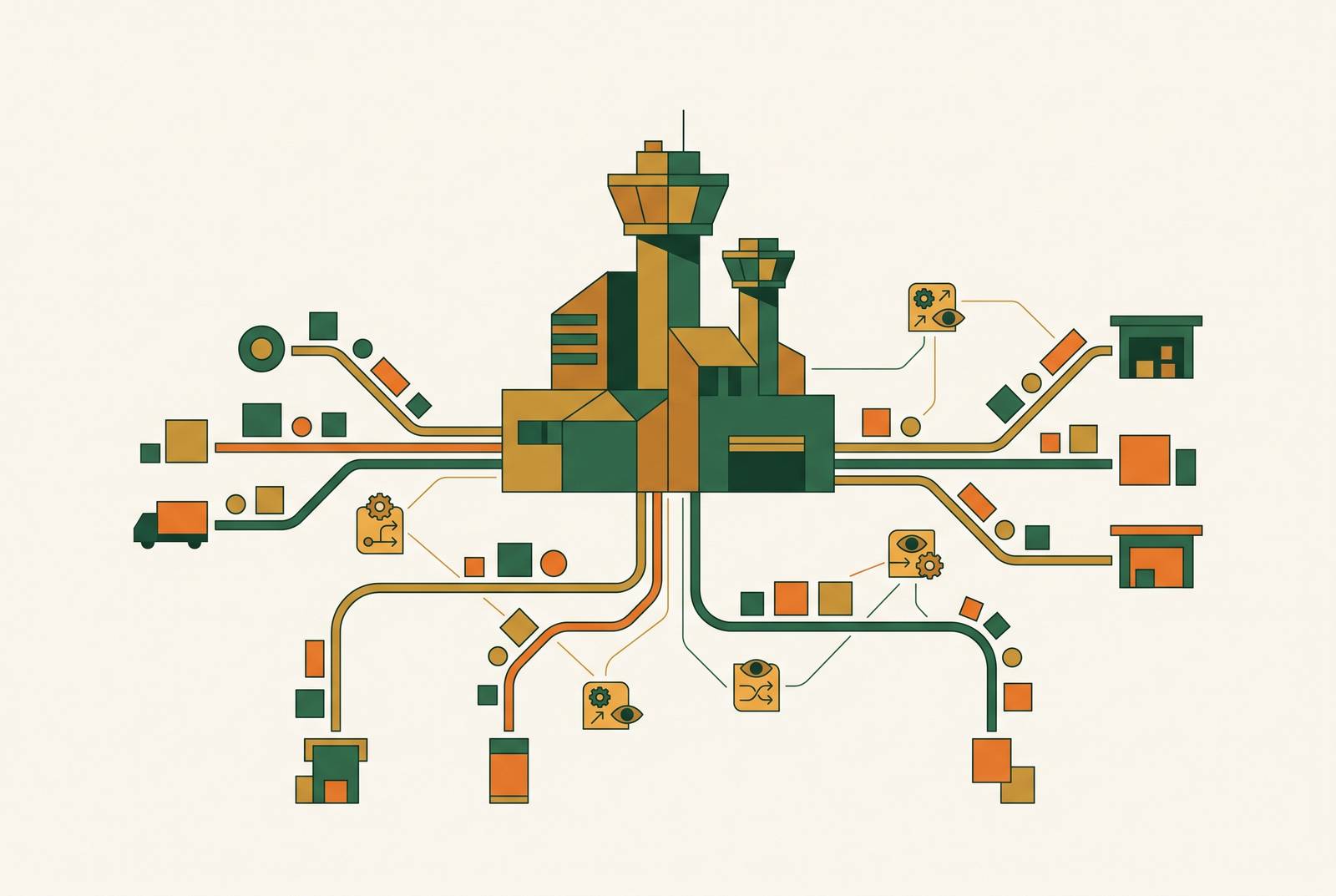
Multi-agent orchestration flips the dispatch architecture around. Specialized agents work across the full constraint surface in real time, replacing a rule-based engine that weighs only a handful of constraints while a dispatcher's judgment fills in everything the engine can't reach, and the dispatcher's job shifts toward exception oversight and coordinating with partners.
Together they produce dispatch decisions that reach optimization a rule-based engine simply can't get to on its own, because no single rule-based engine was ever built to hold that many variables in one decision.
Take the missed-pickup cascade from earlier and run it through this structure instead. The driver gets held at the previous stop, and instead of that fact sitting unprocessed until three phone calls come in at once, the capacity agent flags the delay immediately, the hub agent recalculates whether the dock slot needs to be held or reassigned, and the customer agent pushes a revised ETA out before the customer has to call and ask for one. None of the underlying delay goes away. What goes away is the afternoon it used to cost a planner to manage the fallout.
Three mechanisms decide whether a platform actually captures this kind of value or just looks like it does on a sales call. Dispatch has to be constraint-aware through genuine multi-agent orchestration, with dozens of constraints weighed at once. Re-optimization has to run continuously across the dispatch surface, not as a batch plan built once in the morning and executed regardless of what changes during the day. And the architecture has to handle multiple fleets and multiple carriers by design, absorbing demand swings structurally instead of asking dispatchers to firefight their way through overtime every time volume spikes.
When that exception does arrive, the full context and reasoning behind every step so far is already logged and sitting there waiting for a dispatcher to read it.
A rebuilt dispatch operation tends to run on a small set of specialized agents rather than one general-purpose tool trying to do everything. A workflow agent manages shipments end to end, from the first vendor email to the closed booking. An expert classification agent assigns freight codes, NMFC for LTL classification and HTS for customs tariff classification, accurately and in a form that holds up under audit, in seconds rather than the minutes or hours it takes a person to look them up. A carrier safety and compliance agent monitors compliance on an ongoing basis rather than only at the point a carrier first gets onboarded.
What separates this from older automation tools is that these agents connect to live systems, reason across the data inside them, and act on what they find, retrieving information, making a decision, and following through, with every step logged in a form someone can audit later. They improve continuously as data passes through them.
The autonomy dial: how far to push agent independence in dispatch
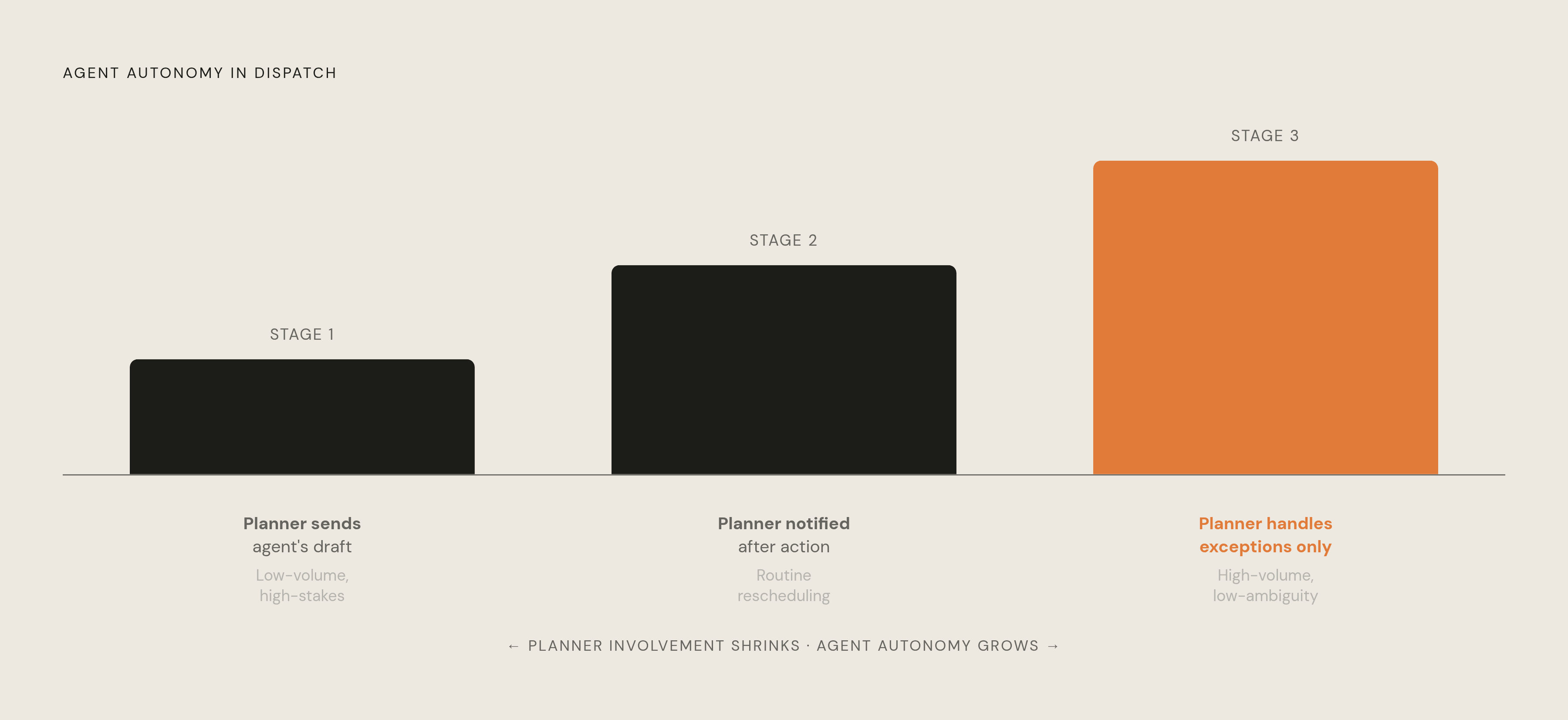
Handing agents control over dispatch decisions is a progression, moved one notch at a time, and the right pace depends on how clean the underlying data is and how well the decision logic behind each step has actually been validated.
That progression has a few distinct stages. In the first, the agent drafts a response or a decision and a planner sends it. In the second stage, the agent acts on its own and notifies the planner afterward, which fits validated, high-volume retrieval work and routine rescheduling where the risk of a bad call is low. In the third stage, human-on-the-loop, the agent handles routine decisions autonomously and the planner's role shifts to supervision and handling the genuine exceptions, which is the target state for the highest-volume, lowest-ambiguity parts of the job.
The first three workflow categories covered earlier, shipment status and ETA, appointment booking and rescheduling, and proof of delivery and document retrieval, are the right place to push toward full autonomy first, because they're high volume, low ambiguity, and the data already lives in the TMS. Exception triage sits at a different level on this dial. Most of the value in triage comes from getting that classification right, because it's the precondition for a planner's time actually going toward decisions that need a person rather than toward sorting work an agent could have done.
This breaks down if the data feeding it is bad. Agents acting autonomously on dispatch decisions will produce flawed outputs at scale when the ERP, TMS, and WMS data feeding them is incomplete or inconsistent, and that gap between a fast deployment and a broken one usually comes down to integration depth, not model quality. Checking how deep those system connections actually go has to happen before any architecture decision gets made, not after.
Where agent deployments fail in dispatch
Most enterprise agent deployments that fail do so for organizational reasons, not technical ones. The conditions that make agents work, clean data, validated decision logic, a workflow that's actually been redesigned rather than just automated, were never put in place before the agents went live, and a dispatch operation that skips that diagnosis ends up reproducing its existing failure modes faster and with less room to reverse course.
Bad data is the most common version of this failure: it caps how well an agent performs and drives flawed outputs at scale, making a bad automation deployment more damaging to a dispatch operation than having no automation.
Agents also fail in ways that have no real equivalent in older automation software, and operations leaders evaluating a deployment should know what to watch for specifically. Tool misuse happens when an agent calls the wrong system or the wrong API for a given task, acting confidently on the wrong source of truth. None of these are exotic edge cases. They're the specific things a dispatch team should be checking for before trusting an agent with more autonomy than it's currently earned, and catching them early is what separates a deployment that recovers from a stumble and one that fails in a way the organization can't walk back. Terminal Use, an AI-first operations firm that deploys live AI agents to rebuild department workflows end to end for logistics, construction, manufacturing, and retail companies, runs a process audit before any agent goes live precisely to close that gap before it compounds.